
At the time of these three letters William’s aunt Charlotte was 29 years of age, living with her brother, the second viscount Courtenay and his family. William Beckford, nine years her junior, was on his way home from travels through the western mainland of Europe. He had left England in June 1780 and returned in April 1781.
We do not know when their correspondence began, but they were acquainted before 1779 when Beckford made his first visit to Powderham and set eyes on William. In the autumn of 1776 Charlotte was visiting Wiltshire where she attended ‘an elegant and splendid ball’ given at Amesbury by the duke and duchess of Queensbury. Beckford was there with his mother and, twelve days later, Charlotte was among the guests for his birthday-party at Fonthill where ‘there was a numerous and very polite appearance of company’.
among those of fashion were the Duke and Duchess of Queensberry, the Earl of Pembroke, Lady Mary Hume, General Paoli, Count Gentiely, the Hon. Mrs. Beckford, the Hon. Miss Courtnay, &c. &c. The ball, which was very grand and splendid, was opened by Mr. Beckford and the Duchess of Queensberry; the country dances began about ten o’clock, and lasted till twelve, when the company sat down to a most superb entertainment, and afterwards danced till near four in the morning.
Bath Chronicle, Thursday 10 October 1776
For more about their relationship, see Charlotte and the calash bonnet.
The tone and wording of the letters indicate that there must have been an extensive correspondence but only these three items survive. Their survival raises some interesting questions: when and why did Charlotte develop ‘the constant habit of burning all her letters’? and why did Beckford take care to preserve these particular pieces when the rest of this correspondence was lost or destroyed? If Charlotte received anything like the draft from 22 January 1781, the letter must have given her serious concerns about the state of Beckford’s mental health and the safety of her nephew in a relationship with him.
The texts here have been transcribed from the manuscripts held in the Beckford Papers at the Bodleian Library in Oxford (England). There are a few minor differences in the first and third from the versions published by John Oliver (The life of William Beckford, pp. 53-54) and Guy Chapman (Beckford, pp. 81-84). Like other letters in the Beckford Papers, these texts may be later fakes rather than authentic drafts or copies. Chapman also quotes from another draft letter dated 11 November 1781: ‘The Myrtle is still alive we brought from Powderham and Wm. every Saturday religiously clips its branches’ (Beckford, p.98). I have not been able to locate this item.
Farinelli (1705-1782) was an Italian castrato singer who lived and performed in London from 1734 to 1737. He retired to Bologna where he died. Ptti. Gasparo Pacchierotti (1740-1821) was also an Italian castrato singer who visited London later in the 18th. century. Beckford engaged him to perform at his coming-of-age celebrations. He died in Padua. Ly. Hamilton (1738-1782) was Catherine, the first wife of sir William Hamilton; he married Emma Hart as his second wife in 1791. Beckford had been staying with the Hamiltons in Naples and Caserta; this is the territory of Susan Sontag’s novel The volcano lover.
West End was the home of Beckford’s mother in Hampstead, in those days still a separate village north of London. In her will Maria Beckford left the house to her son’s two daughters who grew up there. In Venice on his outward journey Beckford had become entangled with members of the Cornaro family. The royal palace of the kingdom of Naples was at Caserta and the Hamiltons spent a good deal of time in the city. Ly. Yong (c.1750-1833) was the wife of sir George Yonge, a friend and adviser of the second viscount Courtenay.
____________
Bologna, Dec. 17th, 1780
‘This Morning I passed with Farinelli who was almost the only singer that ever transported our cold Nation beyond themselves and rouzed such an extravagant cry as ‘One God in Heaven and one F[arinelli] upon Earth’. He happened luckily to be pleased with a certain style of singing and accompanying of myself that I have caught from Ptti. and Ly. Hamilton and all of a sudden I heard that famous voice which has employed so many others in sounding its praises.
His modulation is still delightful and those thrilling tones which raised such raptures in the year ’35 have not yet deserted him. The remembrance of a Period when he was almost deified — of former days and happy hours fleeted away for ever — made him burst into tears. I wish you could have seen us and heard a plaintive sicilian Air I composed to soothe him — perhaps I shall be able to recollect it and play to you upon my return a few simple notes which will ever remind me of Farinelli.’
____________
9 January 1781
‘My only prayer is to live to see you both once more — my sole wish that he may be still sensible of my friendship & lament me should I be forced so young to tread the dark chill pavement of death & futurity. Both these personages according to Northern Mythology inhabit a dismal cave & I seem already to feel the gust which blows from its recesses.’
____________
____________
22 February 1781.
‘I tremble least he should love me no longer as he has done and remain no more 5 hours in my company without desiring any other. Many a delightful Summer’s Evening have we passed together at W[est] End coursing each other round the Lawn and sucking the dew of the leaves of flowers like those fortunate Spirits which Homer describes as wantoning in meads of Asphodel. Pray tell me if your N[ephew] be as fond as ever of these ætherial amusements and if he looks forwards with pleasure to the moment of my return.
Surely he will never find any other Being so formed by Nature for his Companion as myself. Of all the Human Creatures male or female with which I have been acquainted in various Countries and at different Periods he is the only one that seems to have been cast in my Mold.
When I first began to know him the pleasing delusion would often suggest itself of our having been friends in some former existance.
You know he was never so happy as when reclined by my side listening to my wild musick or the strange stories which sprang up in my fancy for his amusement. Those were the most delightful hours of my existance.
T’was then I grew sensible there was a pleasure in loving something beside oneself and felt there would be more luxury in dying for him than living for the rest of the Universe. Good God — were he to receive me with coolness and indifference I should desire to close my eyes for ever!
The World upon reflection is no more than a Desert to me. I pass thousands and Millions without discovering a soul that converses with my own.
In this dreary manner I keep wandering along. Can you wonder then at my anxious enquiries after the sole being who seems destined to cheer my Solitude? T’is certain your B[rother] holds my happiness or misery in his hands and should he continue to oppose your Nephew’s coming to me at F[onthill] my spirits would sink into a dejection which nothing could remove. I cannot understand why he has ceased answering my Letters: explain this mystery if you are able or retain any regard for one who has so much for you. He used to write with the warmest affection and till he was silent I never thought myself unhappy tho’ innumerable reasons conspired to warrant the idea. A languid chill moistens my forehead whilst I write upon this subject. Were I to continue you would imagine me upon the point of flying distracted. My chief treasure, my consolation, my last refuge is centered in Wms. friendship.
The possibility of losing it gives me the most cruel alarms. I dare not pronounce probability, such a thought would throw me into convulsions. Don’t read him this Letter least he should stare and be frightened at its violence. That it may not produce a similar effect upon you is my ardent supplication. You are too well read in the Human Heart not to be sensible of the impatience with which I shall wait your answer. If he cares no more about me or if Ld. and Ly. C[ourtenay] are determined he shall not, let me know that I may try as soon as possible and reconcile myself with my Fate. Give my love to him and let him not be ignorant that he is the first object which enters my Mind when I awake and the last which quits me when I fall asleep. Even my Dreams are full of his Image. You know how it used to haunt me in the gloom of Winter and Fonthill. If the wind sung in the crevices I seemed to distinguish his voice and if I took a lonely walk in the long avenues of the Temple Plantation, his figure stood beckoning of me at the end of the perspective. How often has my sleep been disturbed by his imaginary cries, how frequently have I seen him approach me, pale and trembling as I lay dozing at Caserta lulled by my dear Ly. Hamilton’s Musick and bathed in tears.
You cannot conceive what effects even my compositions have produced when they have had him for their subject, when I almost fancied him leaning upon me as he used to do in the twilight after we had recited our horrid Tales and mutually scared each other with our own imaginations. Several times has he told me with looks that have sunk deep into my spirit, I think we two shall never be at variance and when we die let us be laid side by side in the same dark Tomb.
If any thing could reconcile me to Death t’would be the promise of mingling our last breaths together and sharing the same Grave. Should you perceive in him a pensive melancholy moment seize the opportunity and remind him of his Friend. Tell him that I ressemble him more than ever, that my ferocious spirit has been tamed and that I am now as gentle and humane as himself. Certainly my mind is softened and I am no longer that proud and implacable being insensible to every thing but its own agrandisement. You will not find me altered for the worse I hope. Unless I flatter myself you will think me more likely to maintain than marr your Nephew’s happy dispositions.
Ly. H[amilton] whose affection for me is alone equaled by that I entertain for our lovely Wm. contributed not a little to give me principles and just ideas. Her Letters are now my greatest resource and firmest rule of conduct. It was chiefly to her advice I owe my deliverance from Venice and am worthy at this moment to breathe the same air with the rest of my species.
Let me beg you will be very diffuse when you write to me of Wm. Would to God I could say like the Israelites of their Monarch And all the acts that he did are they not written in the book of the chronicles of M. C. C. [miss Charlotte Courtenay]. You cannot be too verbose upon this topic. Think you are penning a form of tune and repeat over and over again how he looks, speaks and thinks of me. I doat upon his extasies at the Harpsichord, they are so like my own which without vanity I may say have a great deal more foundation than when I left England. Mention if Ly. Yong be still the prime resource. She little thinks I had rather be in her place than mount the Throne of China tho’ I am for ever raving about its splendors. Mrs. Thins I believe too was never before such an object of Envy. In short all those who live move and have their being in his company are more fortunate, according to my ideas, than St. Peter and all his Saints in the conception of a Catholic.’
____________
Images (from the top)
- George Romney (1734-1802), William Beckford, 1782. This painting hangs at Upton-house (Warwickshire, England). https://commons.wikimedia.org/wiki/File:William_Beckford_1782_-_by_george_romney.jpg
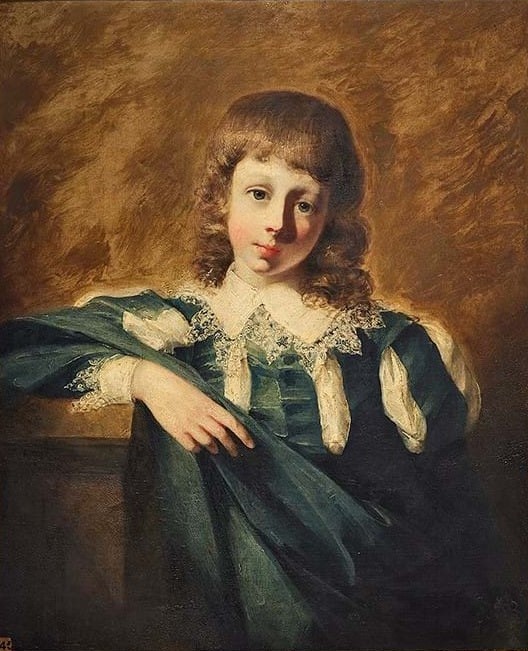
- Matthew-William Peters (1742-1814), [The honorable William Courtenay]. This painting hangs at Powderham-castle (Devon, England). © Charles Courtenay, Earl of Devon.
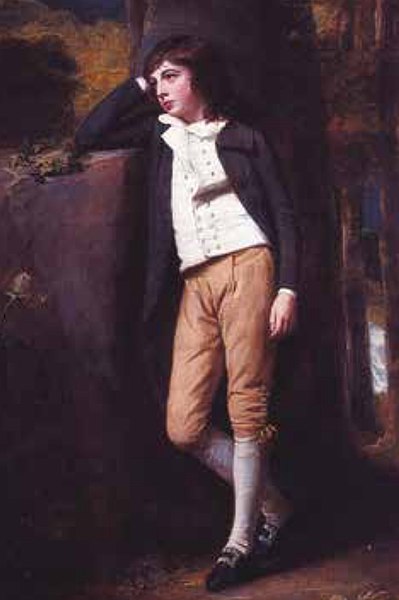
- George Romney (1734-1802), The honorable William Courtenay, 1782. This painting is in the collection of the Nemours Estate (Delaware, USA). https://commons.wikimedia.org/wiki/File:William_Courtenay_-_Kitty_1.jpg
Romney’s pair of sombre paintings suggest that he may have taken a dislike to his sitters. They are in striking contrast with the flamboyant portraits of Beckford and the young Alexander Hamilton that Joshua Reynolds painted in 1782.
____________
Page history
- 2022 March 21: first published online with just two letters.
- 2025 October 20: revised version published with letter of 9 January 1781 and information from 1776.
 William Courtenay (1768-1835)

