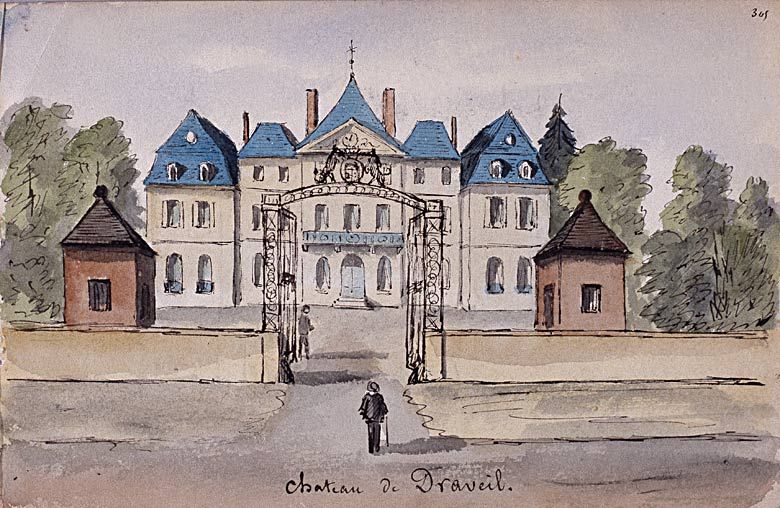
In October 1814 William and his suite sailed from New York on board the Gustav Adolph, bound for France. His cousin Robert-Edward Clack and servant William Howe made their way back to Devon, but William never returned to his home county after December 1810 when he travelled from Powderham to Liverpool for the journey to New York. George Woods, William’s ‘faithful servant’, stayed with him in France at residences in Paris and also from 1821 at Draveil.
[…] the magnificent château that Marin de la Haye built at Draveil, about twelve miles south of Paris. De la Haye purchased the property in 1720, only two years after he had obtained the lucrative office of royal tax collector. Provided with sufficient means to establish himself in society, De la Haye transformed the simple house he found at Draveil into a large château with spacious and varied gardens. At the axial center of the house was the grand salon, which he used as the state room for formal receptions. To demonstrate his wealth and status, the salon was decorated with immense mirrors, carved and gilded paneling, and sculpted reliefs. The room opened through three round-headed doors onto a balcony that overlooked the celebrated park.
(Grand Salon of the Château de Draveil, Philadelphia Museum of Art)

William bought the chateau at Draveil in 1821 from its American owner Daniel Parker. Much of the estate was sold to other purchasers but the remaining grounds were still extensive. George R. Russell left a description of Draveil as he knew it in 1814-15 when Daniel Parker was owner. His account was published in 1856 by Richard Henry Lee (Memoir of the life of Harriet Preble, pp.24-27):
“The estate of Draveil was situated about fifteen miles from Paris. It was a princely domain of great extent, and, with its farm houses and accommodations for its numerous flocks and herds, occupied much ground apart from the mansion. The cultivation of the land employed many laborers, and most of the inhabitants of the village were entirely dependent on the proprietor. Some of the vestiges of a feudal age could be discovered in the tenure of service, and the levelling authority of the Revolution had not deprived the little hamlet of its reverence for the lord of the manor. But that which, in the olden time, might have arisen from the dread of irresponsible power, was now a free offering to a generous and noble-hearted man, who was honored and beloved by all who rejoiced in his friendship, or partook of his bounty.
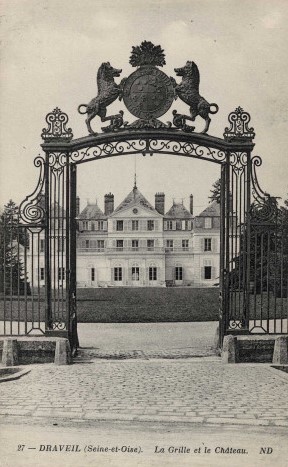
“An avenue, a mile in extent, bordered by forest trees, led to the spacious court-yard in front of the chateau, which was a large, fine old structure, built with an equal regard to architectural effect and personal convenience. It was both commodious and elegant, and its long suite of rooms, including an excellent library, combined all that could be desired for comfort or luxury. Most of the domestics had grown gray on the estate, and seemed, like the trees, to be identified with it. There was an affectionate relation between them and the family – the result of mutual dependence; of kindness and consideration on one side, and attention and fidelity on the other. The out-buildings were in a corresponding style of magnitude and appropriateness, and in a profusion that left nothing wanting which could be adapted to the various wants of a liberally provided household. There were stables, with inmates worthy their ample accommodations. There were rooms for everything – fruit, bathing, billiard, laundry, with many others whose uses I have forgotten. There were gardens which I never can forget, where the fruits of many lands were congregated, and, conspicuous among all, the golden châsselas, luxuriating in its native region, hung clustering from the walls in rich and prodigal abundance.
“The chief beauty of this enchanting place was the magnificent park, overlooked by the chateau, covering an extent of ground which admitted winding and varied walks and drives, amidst the productions of every clime that could be naturalized in sunny France: there seemed no end to the loveliness of this fairy realm. Art had lent its aid, but had cunningly concealed its work, that nature might claim all the merit as her own. The little lake, embowered in trees, the arched bridge, the sylvan retreat that defied the sun, the rural cottage or crumbling ruin, or fantastic grotto, which come suddenly before you, were all appropriate parts of the great whole, blending in unity, and seemed to have grown where they were situated, as a fit accompaniment to the waving woods. Beyond the park stretched the broad acres of the estate bounded by the glancing Seine.
“Taste and wealth had been profusely expended on everything attached to this sumptuous residence, and they had given results over which the eye never tired. There was a repose and tranquillity which shut out the busy world, and one forgot that, within a few miles, the most stirring and gorgeous city of the earth rocked and roared in its never ceasing agony of cares and passions. Yet a memento of the convulsion, which was still shaking Europe, was distinctly visible from the chateau. The direct road from Fontainebleau to Paris lay on the further bank of the river, and the post-house could be easily pointed out where Napoleon first met the intelligence of the battle of Montmartre, and the entrance of the Allies into his capital. He had stemmed the tide of invasion with an ability worthy a better fate. With the mere remnant of an army, he had contested its advances foot by foot, and all Europe in arms had well nigh turned back in dismay from his superhuman exertions. His genius never blazed with such intensity as on that wide and continued battle-field, from the Rhine to Paris; and had his last bold move been aided by means, in any degree commensurate to the fearful odds opposed to him, his innumerable foes would have turned their faces to the frontier in precipitate retreat. But his weakness gave them courage, and feeling that their only safety was in audacity, they disregarded his movement and marched on Paris. He had counted too strongly on their fears, and seeing the failure of his manoeuvre, he made one more attempt to redeem his fallen fortunes and place himself between them and the capital. Leaving his thinned and worn-out forces to follow him, he hurried, with headlong speed, towards Paris, and had reached the post-house I have named when he was met by retreating soldiers, who told him all was over. It was an interesting spot, skirting the landscape across the lawns and glades of Draveil, for it was there the conviction first flashed upon him that his empire had ended; and, in looking at it, the thought arose how his iron soul broke down, for the first time in his eventful career, as he turned back to Fontainebleau, hopeless and desolate in his utter despair.”

- 1833 Morning Post, 21 October 1833:
The Earl of Devon has purchased the magnificent Chateau de Draveil, on the Seine and the Oise, situate a few miles south of Paris.
- 1835 Southern Reporter, 20 June 1835, p.4:
Paris Correspondent. Lord Devon’s Chateau de Draveil, with its magnificient collection of Exotics, which are to be sold for the benefit of the legatees, is now thrown open for daily visitors; and several parties of pleasure and picnics have taken place in its hitherto secluded lawns. So fastidious was Lord D. in his household arrangements, as to institute fines among his gardeners and workmen, for every piece of paper, rag, bone, or unsightly object left in the park or premises. | It may not be amiss to acquaint the affluent and humane, that the ex-sovereign of fashion, Poor Brummell, is languishing in a prison at Caen, with scarcely a sufficient provision to supply him with the commonest necessities of life; and such is the state of his health, that their liberality cannot be too speedily administered. (George Brummell survived until March 1840.)
- 1839 Western Times, 13 July 1839:
A letter from Paris gives an account of a dreadful fire occurring on the 2nd inst., at the farm De Draveil, formerly the property of the late Earl of Devon, and for some years occupied by G. Wood, Esq., of Elwill, near Kenton. It caused the greatest excitement in the district surrounding for many miles, and the loss is stated to be very considerable, there being upwards of 300 sheep destroyed, with a vast quantity of valuable produce.

Images (from the top)
- Charles-Albert Capaul: château de Draveil, between 1882 and 1902. (c) Région Ile-de-France – Inventaire général du patrimoine culturel, (c) Conseil général de l’Essonne.http://inventaire.iledefrance.fr/dossier/chateau-de-draveil/d4dd31ba-2bb8-42ba-b3fb-4d97d89b7abb
- Grand Salon of the Château de Draveil, Philadelphia Museum of Art. https://philamuseum.org/collection/object/42061.
- La Grille et l’Avenue du Château. https://francearchives.gouv.fr/fr/facomponent/d74e6dbc9254ea8ba840c76c21b43b23978c7a3a.
- La Grille et le Château. https://francearchives.gouv.fr/fr/facomponent/7842f5cb367bdd368dee2c7407a611da548c0f18.
- La ferme seigneuriale. http://www.histoiredraveilvigneux.fr/Societe_histoire/Draveil/chateau_draveil.html.
Page history
- 2024 October 9: first published online.
 William Courtenay (1768-1835)