- 1784 William Beckford in a letter to Samuel Henley, London 6 May.
William I believe quite lost in flowers & foolery at present, perhaps you may raise him out of the lap of idleness, but the task will be difficult.
- 1790 William Speechley (gardener to the duke of Portland), A treatise on the culture of the vine. ‘The Viscount Courtenay’ is included in the list of subscribers.
- 1798 Western Flying Post, 15 October 1798, p.1.
Western Apiarian Society | Instituted for promoting the Knowledge of the best Method of managing Bees. | At a Meeting of this Society, held at the Globe Tavern, Exeter 5, 1798, | Abraham Girod, M.D. in the Chair; […] Resolved, That […] the Right Hon. Lord Viscount Courtenay […] be admitted members of this Society.
- 1798 or 1799 John Kennedy & Henry Cranke Andrews, The botanist’s repository, for new, and rare plants; vol 1. [The title page to this first volume is dated 1797 when serial publication began; the author’s preface is dated October 1799 at Knightsbridge.]
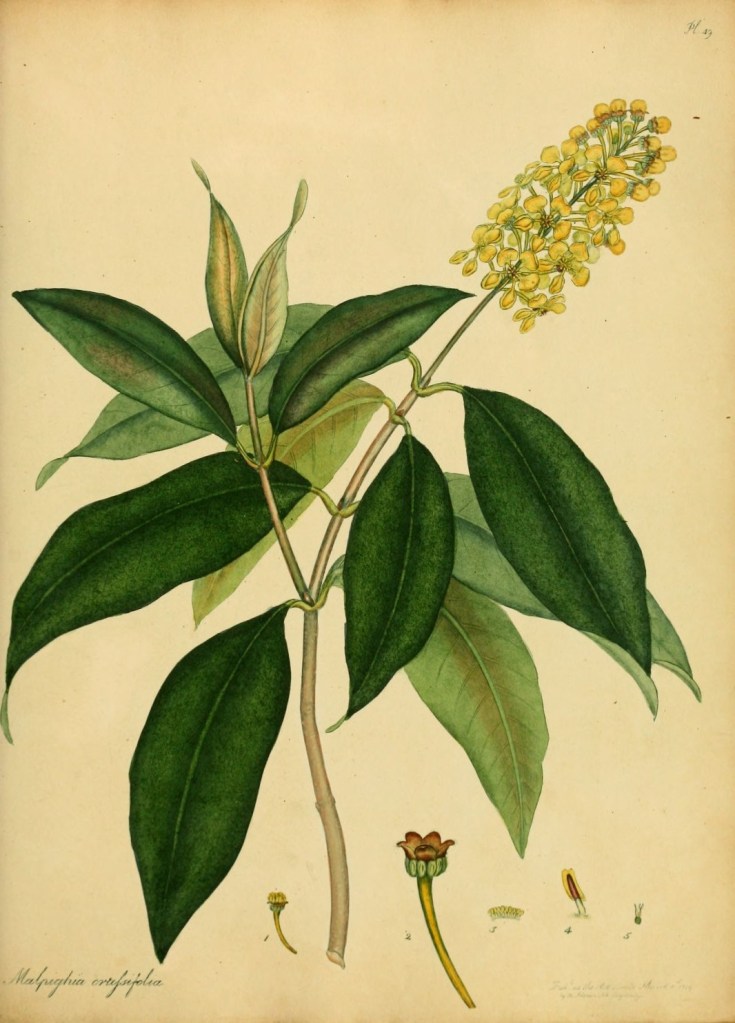
Plate XLIX | Malphigia crassifolia | Thick-leaved Malpighia | Class X. Order III | Decandria trigynia. […] Our species makes a very handsome hothouse plant, growing to the height of five, or six feet, before it flowers. It is a native of Jamaica, and most of the adjacent islands, and was introduced by Messrs. Lee and Kennedy about the year 1792. From the extreme tenderness of the young leaves, and shoots, it must be kept in a strong growing pine heat during the winter months; otherwise, they are subject to damp off. It is raised by cuttings, and seems to delight in a rich soil. The figure was made from a specimen communicated by the Right Hon. Lord Viscount Courtenay, in whose most superb collection at Powderham Castle, near Exeter, it flowered, for the first time in England, in the month of September 1798.
- 1799 John Swete in his journal for May 1799, edited by Todd Gray and Margery Rowe as Travels in georgian Devon, 1997-2000, vol. 4, pp. 130-131.
[in the grounds of Powderham-castle] Under a hanging wood composed of an intermixture of firs and forest trees, hewn from the living rock, and separated from the Park by a high pale, is here to be seen a Grotto; not one of those damp subterranes, from whose dropping roof the pendulous Stalactites hangs, and over whose fretted floor the chrystalline rill gurgles: but a dry, cool Excavation, forming a delicious retreat from the Summer Sun. The shelly decorations intermingled with spar and moss, owe their arrangement to the taste of the fair Sisters of Lord Courtenay, by whose hands also have the Roses been planted, and the Woodbines trained which o’er canopy the entrance of the grot, and fill it with perfume. […] on a glade, in part open to the Sun are the pleasure gardens, formed within the last ten years by the direction of Lord Courtenay; These are much visited; and consisting of Pastures of the most beautiful flowers, interchanged by close shaven lawns, shrubberies, and a Summer building forming at once an elegant room and a conservatory for curious plants certainly deserve the attention of every Visitor of Powderham.
- 1800 Gentleman’s magazine, vol. 70 part 2 | December 1800, p. 1125 | letter of 30 September from ‘Investigator‘ concerning Powderham.
I went a few years since to view the castle […] There were some fine old lemon-trees, in full bearing, that grew in the natural ground at the end of a terrace, which were remarkable for being the first planted in the open ground in England. They were covered with glass frames only in the severity of winter; for the climate there, though rather less healthy than the opposite shore, is indisputably the Montpelier of England. There were also at that time at large in the park a nice breed of pyed pea-fowls
- [c. 1800] Elizabeth Ham by herself, edited by Eric Gillett, 1945, pp. 50-51.
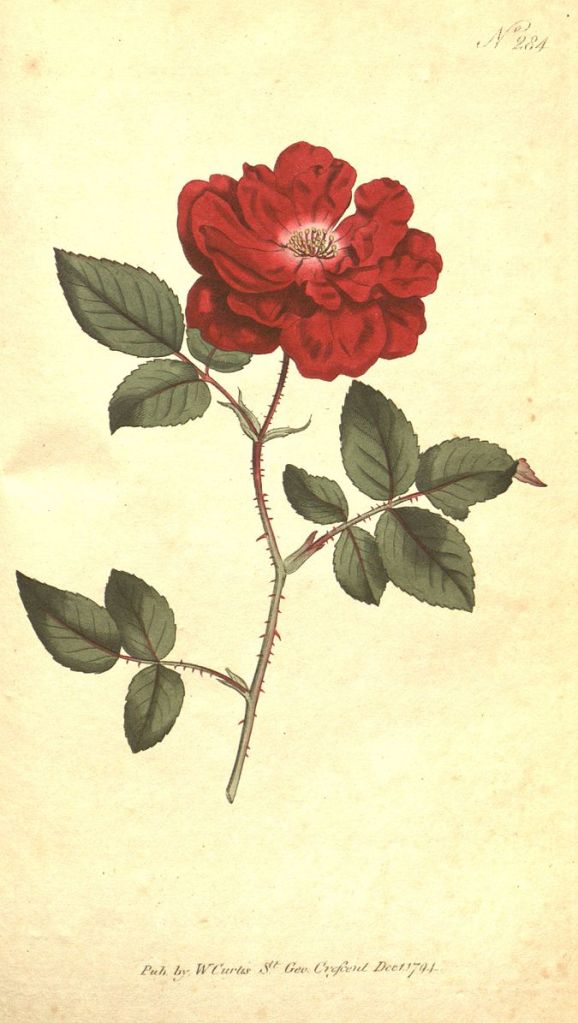
It was there [Powderham-castle] I first saw the China or monthly rose [Rosa chinensis Jacq.] growing in the open air. It covered the whole front of a beautiful Pavilion and was in full flower. I thought I had never before seen anything so pretty.
- 1802 Trewman’s Exeter Flying Post, August 2.
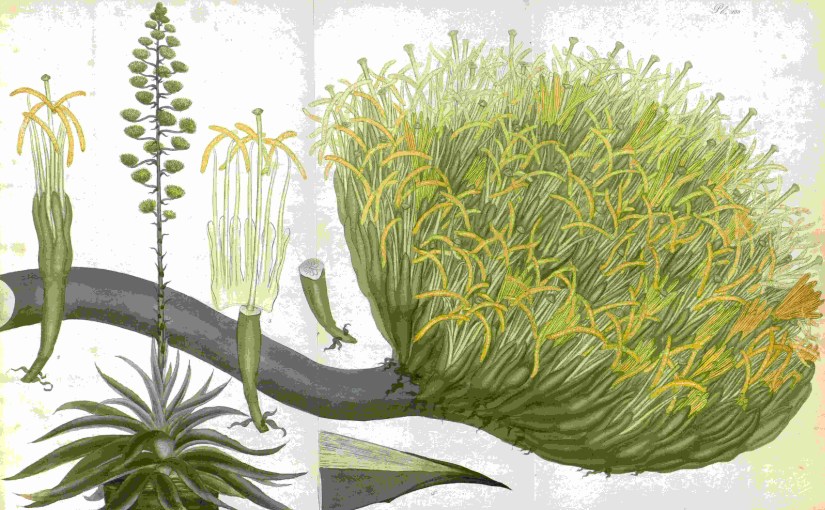
There are two great American aloes [Agave americana] in the orangerie of the Right Hon. Lord Borringdon, at Saltram, near Plymouth, one of them showing evident marks that it would blossom soon in full bloom, was removed for security, and to promote its blossoming in safety, by direction of Mr. Smith, principal gardener, and by order of the Right Hon. Lord Boringdon, from the orangerie into Saltram gardens, for the inspection of the curious in botany. There have been two of these grand plants that have blossomed in the last century, in the county of Devon; one about twenty-five years since at Powderham-castle, the seat of the Right Hon. Lord Courtenay; and a second about thirty years since blossomed in a gentleman’s garden at Salcombe, in the South-Hams, which at that time produced great profit to the respective gardeners, who exhibited it to the curious. [Agave, botanist’s repository vol. 7 plate 433 CCCCXXXIII. ‘Our figure was made from two plants at Kensington Gore, each bearing 2000 flowers, and about 70 years old, belonging to J. Vere, Esq.’]
- 1803 Henry Cranke Andrews, The botanist’s repository, for new and rare plants, vol. 4, plate CCLXXXVI, Hibiscus Patersonius.
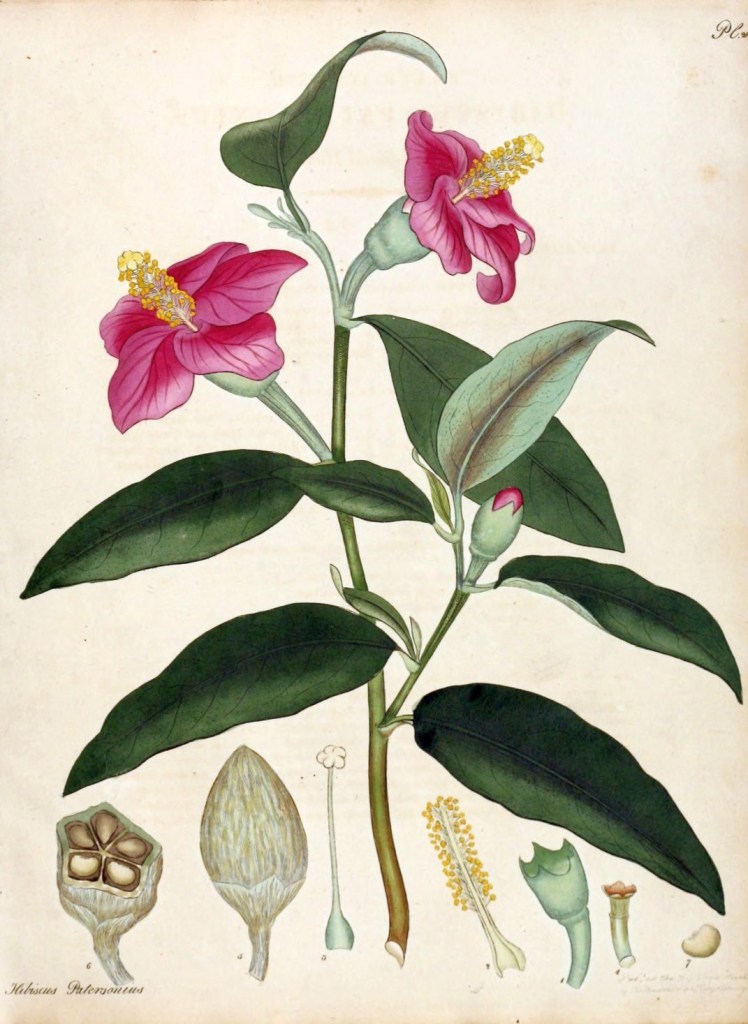
The Norfolk Island Hibiscus is a tender greenhouse plant; was introduced to Britain, in the year 1792, having been raised from seeds communicated by Col. Paterson, then stationed on that Island. It attains the height of 12 feet, or more, becoming a small tree; may be increased readily from cuttings, and should be planted in a mixture of loam and sandy peat. Our figure is from a specimen received from the Right Hon. Lord Viscount Courtenay, in whose collection at Powderham, near Exeter, it flowered for the first time in the year 1800; and where also the seeds ripened.
- 1803 John Britton & Edward Wedlake Brayley, The beauties of England and Wales, vol. 4, pp. 95-96.
The grounds of Powderham are extensive, finely planted with deciduous and exotic trees, and diversified with some bold swells. […] The park and plantations belonging to this domain, extend through a circumference of nearly ten miles; and the pleasure gardens behind the house are replete with a vast number and variety of flowers and botanical rarities.
- 1807 George Tod, Plans, elevations and sections of hot-houses, greenhouses, an aquarium, conservatories, &c.
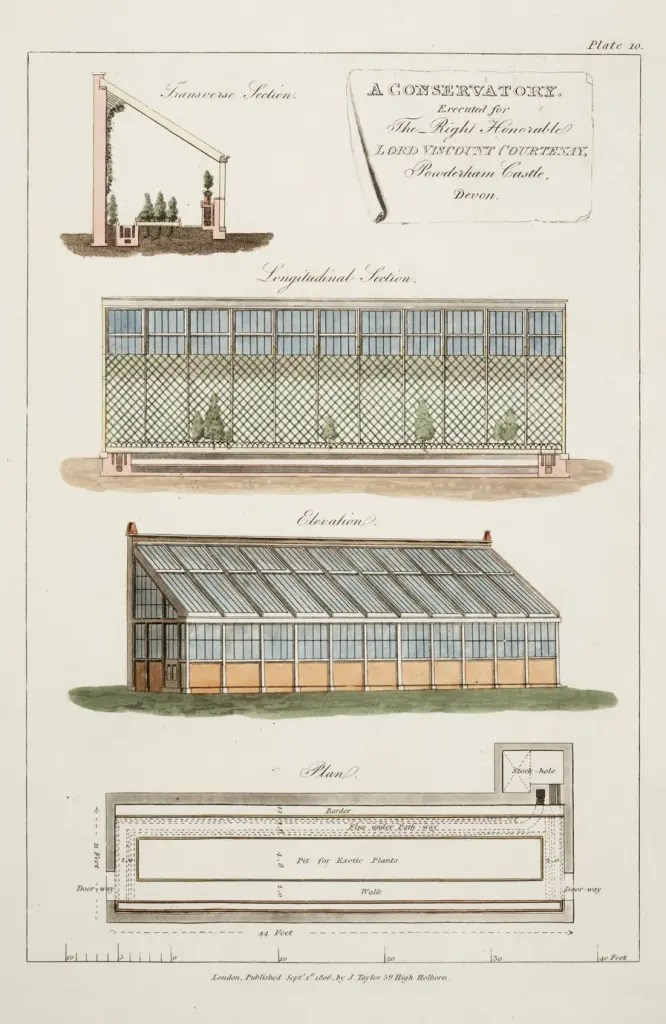
A conservatory to be executed for lord viscount Courtenay, at Powderham castle, Devon. | One fire, and a single flue goes round this house; the front part above the floor, the other under the pathway. A narrow border is formed along the back wall, which gives growth to plants trained upon a treillage fixed against the wall for that purpose. The front and end sashes are made to draw down from the top, for the purpose of admitting air. The top lights on the roof are made to slide, and to be taken entirely off in the summer. Plants, &c. are plunged or planted in the pit, which is level with the walk, and is bounded by a stone border, on which are formed small Gothic arches, with wire work. A small arch is formed with treillage under each rafter, at the angle it makes with the back wall.
- 1810 Moy Thomas in his diary | Bath Central Library, MSS 1859 | Todd Gray, The garden history of Devon, 1995, p. 182.
the garden, greenhouse and hot-house are kept in very nice order and there are some fine plants & shrubs in the greenhouse, the grounds are extensive stretching a considerable way along the banks of the river Exe.
- 1815 John Feltham, A guide to all the watering and sea-bathing places | A new and improved edition, London, p. 286.
[Powderham-castle] The flower-garden and conservatories highly merit notice; as does the view from the Belvedere.
- 1816 Trewman’s Exeter Flying Post, 18 July 1816.
Pine apple plants. | For sale, at Powderham Castle Garden, (the whole of which must be disposed of before the 1st of October next,) all the stock of fine pine apple plants, amongst which are Eleven Dozen Plants fit for fruiting next year, and 13 Dozen of Succession Plants, all strong and healthy. A most desirable opportunity now offers for any Gentleman who wishes to stock his Pinery, as by an early application, he may select any part of the above mentioned. Apply to William Hall, Gardener, Powderham.
- 1819 New York Evening Post, May 25. Courtesy of Old Fulton Postcards.
Green House Plants | The elegant collection of Green House Plants, selected by Lord Courtenay, with much care and a very considerable expence, will be sold by Mills, Minton & Co. in Kirk & Mercein’s room, tomorrow, at 11 o’clock A.M.
- 1820 John Pike Jones: A botanical tour through various parts of the counties of Devon and Cornwall, p. 3.
Powderham Castle, the magnificent seat of Lord Courtenay, is surrounded with fine plantations. The pleasure-grounds are extensive, and laid out with considerable taste. The gardens contain a noble collection of exotics; many of the plants had attained an extraordinary size and luxuriance, occasioned most probably by the mildness of the air.
[White water-lilies flowered in the marshes, pools and canals at Powderham and, though ‘hardly wild’, Jones included Nymphaea alba in his ‘List of plants growing wild in the vicinity of Chudleigh, and in various parts of the adjoining hundred of Teignbridge’.]
- 1821 madame Henriette Campan in a letter to Hortense duchesse de Saint-Leu, Draveil 24 October.
Nous avons déjà ici des dahlias doubles d’un lilas superbe, mais le lord qui habite le château de Draveil [William] en a de toutes les couleurs qui sont gros comme des têtes de pivoines. Il a payé chaque bulbe 25 guinées, et le loup-garou les fera brûler plutôt que d’en donner à ses voisins.

[We already have some double dahlias here of a suberb lilac colour, but the lord who lives in the château at Draveil has them in all colours with heads as big as peonies. He paid 25 guineas for each tuber, and the rough/rude beast would rather burn them than give any to his neighbours.]
- 1824 John Wilkinson in a letter to William at the château de Draveil, Tuesday 4 May. Wilkinson had visited Powderham in the second half of April 1824.
Passing from the castle to the garden I enter into another person’s jurisdiction, and that person I know is no favorite of your Lordship’s. If I may be permitted however to express an opinion, as to the mode in which he discharges his duty from the observations I could make, I should say that there cannot be much, if any ground for complaint at present. I am a great admirer of plants but do not profess to be any judge as to their merits or particular claims for admiration. I can only say that Hall has an amazing large collection and according to my notions a most beautiful one. I certainly never saw any to equal them. […] With the management of the gardens and the arrangement made with Hall two years ago as to them and the preservation of the shrubberies and walks around the castle I have not interfered with. As respects the preservation and appearance of all these things I am convinced any alteration would be no improvement. As to the terms on which Hall holds the gardens I can scarcely venture to express an opinion about them. The rent he pays is certainly a mere nominal one, but the expense of keeping up the different hothouses etc. etc. must be very great, and if it be true as Mr. Pidsley informs me it is, that almost all the surrounding gentry in the neighbourhood of Exeter sell plants and the surplus produce of their gardens, the prices must naturally be so diminished as most materially to affect any profits Hall may make.
- 1825 The repository of arts, literature, fashions &c, p. 194 | Powderham-castle, Devon, the seat of lord viscount Courtenay.
The gardens attached to the castle are extensive, and have been kept in the finest order: its flower-gardens likewise have been celebrated for their arrangement and choice collection of costly plants. The grounds are beautifully laid out, and so blend with the flower–garden, as to form a lovely whole. Here is still to be seen the rare exotic growing in all its native luxuriance, combined with the temple, the orchestra, and banqueting-room, that once gave life and soul to the scene.
- 1827. May. In a letter to or from mrs. Jane Grimston of Yorkshire. East Riding of Yorkshire Archives and Local Studies Service, Beverley | DDGR/45/13. The text here is copied from Todd Gray, The garden history of Devon, 1995, p. 183.
You are a wicked woman for not being in raptures with Powderham. Who told you to expect carnations or anemonies or common annuals? In former days when the family were in its glory, tho to be sure their whole souls seemed wrapped up in their garden, they used to go when breakfast was over in open carriages & stay all day, dining there, a band of music under the trees, dancing on the grass, acting plays.
- 1829 Western Times, 21 March 1829, p.4.
Devon and Exeter Botanical and Horticultural Society. | A general meeting of the Subscribers and others friendly to this institution took place on Tuesday last, at Congdon’s Royal Room, to receive the report of the committee appointed at the previous meeting. There was a numerous and highly respectable attendance, and upwards of 70 names were entered as subscribers. | John Milford, junr. Esq. having been called to the chair, stated the purport of the meeting, […] Mr. Milford concluded by putting the rules & regulations, which were carried unanimously.
[A full list of the subscribers and officers was printed in the Exeter and Plymouth Gazette of 21 March 1829; William’s name is not included, nor that of any gardener from Powderham. The society held its first exhibitions in July and September 1829 at Exeter.]
- 1829 Mary Poulton>Dawkins, as quoted in Wilson Rose, All Together Once More: the Poultons and Ladshaws in America, 2012, p. 53.
in the summer of 1829 […] at Powderham Castle we had peaches and nectarines from trees nailed like grapevines to the fruit garden walls.
- 1829 Annales de l’institut horticole de Fromont | Fourquet, Jardinier-chef des pépinières: Rapport sur les opérations de Greffe herbacée, exécutées dans le Jardin de Fromont en mai et juin 1829. | p.165.
Au Directeur de l’Institut horticole. | Monsieur, j’ai l’honneur de vous rendre compte que les greffes herbacées que vous m’aviez prescrit de faire ont été effectuées, sous mes yeux, du 11 mai au 6 juin, sans autre interruption que les dimanches, par deux de nos bons jardiniers, Josselin et Hatesse, et deux candidats d’horticulture, Blanchard et Levacher […] Ces quatre hommes ont été occupés à l’opération pendant l’espace de vingt-cinq jours. Dans cet intervalle, il a été opéré deux mille deux cent soixante-trois sujets d’Azalées en pots (Azalea pontica) […] Environ cent cinquante espèces ou variétés et hybrides d’Azalées ont été multipliées ainsi. On y remarque une vingtaine de sujets de l’Azalea sinensis lutea, nouvelle espèce d’orangerie encore rare, végétant parfaitement bien […] Il a été vendu un de ces sujets de l’Azalea sinensis lutea, au bout de quarante-trois jours de greffe, à M. John Ballander, jardinier de lord Courtenay, propriétaire du château de Draveil.
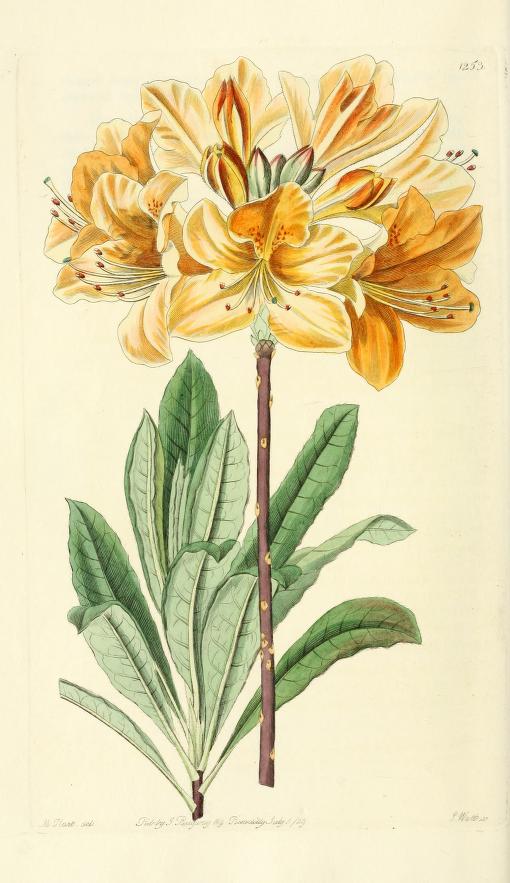
[The horticultural institute in Fromont lay south of Paris and only a few kilometres from Draveil. In 1829 a small team of gardeners and students there had been attempting to graft more unusual varieties of azalea on to stocks of Azalea pontica. They were particularly successful with grafts from Azalea sinensis lutea, ‘a new and still rare type of hothouse plant’. There were some twenty healthy plants and one of these, forty-three days after grafting, was sold to ‘Mr John Ballander, gardener to Lord Courtenay who owns the château de Draveil.’]
1829 Woolmer’s Exeter and Plymouth Gazette, 6 June 1829.
There is at present in Powderham Castle Garden the most beautiful show of the newest and best varieties of the Geranium tribe, perhaps, ever seen in the West of England.
- 1831 Devon and Exeter Gazette, 18 June 1831.
There is to be seen at the Powderham Castle gardens, now in full bloom, about 500 plants of the most splendid variety of the geranium tribe, perhaps ever beheld.
- 1834 John Claudius Loudon, Arboretum et fruticetum britannicum, 1838, vol.1, pp.xv & xvii.
In 1834, before the Arboretum was commenced, about three thousand printed lists of trees and shrubs, agreeable to the form shown in Appendix No. I., were put in circulation; and answers to these, or other information relating to trees and shrubs for this Arboretum, were received from the following persons: […] Devon, W. Earl of. [William].
- 1835 Western Times, 31 January 1835.
Remarkable Foreign Trees In England. — The largest tulip tree that I ever saw in England is at Mount Edgecumbe; the largest cork trees and ilices at Mamhead; one of the largest cypresses is at Powderham Castle; the largest cedars are at Wilton; a remarkable one is also at Althorp. A large deciduous cypress at Port Eliot, and another at Ken Wood. — Correspondent of Gardiner’s Magazine.
- 1835 Jonas Dennis, The landscape gardener, London 1835. The rev. prebendary Dennis of Bradford House near Exeter dedicated his work to Colt Hoare, 25 March 1835.
[pp. 17-18] The deepest-tinted, thickest, and in all respects finest grass was produced in the plantation-gardens of Powderham Castle in Devonshire, during the proprietor’s occupation. It was mowed, brushed and rolled in summer thrice in a week, and annually manured. | [pp. 72-3] During the occupancy of Powderham Castle its plantation garden was deliciously odoriferous, toward the close of August or commencement of September; aromatic plants and shrubs of diversified species, uniting in supply of contributory scents.
- 1835 Woolmer’s Exeter and Plymouth Gazette, Saturday 16 May 1835, p.3.
Devon and Exeter Botanical and Horticultural Society. | The first exhibition of this Society for the present year took place yesterday (Thursday), at Congdon’s Royal Subscription Rooms. There was an abundant supply of the most rare and beautiful of the Floral tribes, which were tastefully arranged; the display being enriched by contributions from the gardens and conservatories of the Earl of Devon [William], Lord Rolle, Sir T. D. Acland, Sir J. Kennaway, Mrs. Wells, Dr. Tayleur, Dr. Miller, E. Granger, Esq., Col. Wright, E. Gattey, Esq., R. Sanders, Esq., Rev. R. Stephens, G. F. Travers, Esq., W. Gifford, Esq., J. Sweetland, Esq., Mr. Saunders, Mr. Clarke, Mr. R. Webber, Mr. W. Rowe, &c. &c. But the Society were again particularly indebted to those spirited Nurserymen, Mr. Veitch, and Messrs. Lucombe and Co., who exhibited extensive and magnificent collections; Mr. Dymond, and Mr. Manley of Heavitree, had small collections, but very choice and select. The Fruits and Vegetables were also of very fine quality.
1835 Inventory of heirlooms at Powderham-castle, June 1835.
Park: Stone Roller with Wood frame. Garden: 9 Lights and 3 Frames for Cucumbers | Ditto and ditto for Melons | one Dozen Stove Plants in sorts | 2 Stone Rollers | Iron frames | 6 Watering pots | Garden Engine | 2 Spades | 2 old Stoves | 4 Awls | 4 Dutch Awls | 4 Dung forks | two Step Ladders | Line and Reel | 2 Dutch hoes | 3 pair Garden Shears | 21 hand Glasses | old Garden frame &c. | Corner Cupboard, Press Bedstead | old Table | Pair of edging Shears | 7 Grape Glasses | old chair | 4 old Flower baskets and Sundries. Mr. Halls Room: Marble top Table | Green painted Table | 6 old Chairs | Painted Cupboard | Painted desk | Old Fender and Fire Irons | Lead Cistern | 2 ditto | Sun Dial and Pedestal. Orange house: Stands | 12 Lemons and Oranges in Iron bound Tubs | 2 large Clethea Arburea | one large Laurus Camfora | Norfolk Pine | Mahogany Tree | one double red Camilla | 4 large Camillas in sorts | 4 dozen Greenhouse Plants different varieties. In Greenhouse: Ericas, Diasmas, Ficoides and Crossulas in Pots about 6 dozen in sorts | 4 dozen Geraniums in sorts | one dozen American Aloes | 6 dozen Garden pots | one Lead Cistern. Pavillion Gardens: 2 Rolling stones and Iron Frames | 2 iron Rollers | 5 Watering pots | one pair Steps | Ladder | 4 hand Glasses | 2 pieces of Tapestry | Lot of Garden Tools | Ladder and Wheelbarrow.

- 1836 Woolmer’s Exeter and Plymouth Gazette, 4 June 1836, p.3.
[Exhibition on 2 June 1836 of the Devon and Exeter Botanical and Horticultural Society] J. W. Buller, Esq., took the Chair, and said he appeared before the company on the present occasion as the humble representative of their Noble President (the Earl of Devon [William’s successor]), whose absence he regretted much as any one in the room, for he felt that the Society was under great obligations to that Noble person, who was a warm friend and patron of Botany and Horticulture. — (Hear, hear.) He rejoiced that one of the most splendid domains in this county had fallen by inheritance to that Nobleman, because he felt assured that he would continue to keep up those beautiful and extensive gardens which had long been the pride and ornament of the county.
- 1838 John Claudius Loudon, Arboretum et fruticetum britannicum, 1838, vol.1, p.266.
Magnolia grandiflora South of London. As standards, the largest are at Powderham Castle, and at Coombe, near Plymouth; at both places upwards of 30 ft. high: at Saltram, 60 years planted, 25ft. high: at Killerton, 18 years planted, the Exmouth variety has attained the height of 23 ft., and flowers nine months in the year. […] Examples of Magnolia grandiflora against a wall, growing vigorously, and flowering freely, might be given by hundreds.
- 1842 Gardener’s magazine. Vol. 8 new series. November 1842, Notices of some gardens and country seats in Somersetshire, Devonshire, and part of Cornwall. By the Conductor [= John Claudius Loudon].
[7 September 1842.] Powderham Castle; the Earl of Devon. The fine magnolia trees and other exotics here are sadly neglected; the branches are unpruned, the stems covered with lichens and moss, and the plants choked up in many places with the commonest trees and shrubs.
~~~~~~~~~~~~~~~~~~~
Further information
- 1995 Todd Gray, The Garden History of Devon | An illustrated guide to sources.
- 2018 Rebecca Wilkinson Flemer, The American Garden at Powderham: “Delightful Retreat in the Plantation”. https://core.ac.uk/download/219378419.pdf.
~~~~~~~~~~~~~~~~~~~
Images (from the top)
- Henry Cranke Andrews, The botanist’s repository, for new, and rare plants. Vol. 7, Plate 433, Agave americana.
- Henry Cranke Andrews, The botanist’s repository, for new, and rare plants. Vol. 1, Plate 49, Malphigia crassifolia.
- William Curtis, The Botanical Magazine; or Flower-Garden Displayed, Vol. 8, Plate 284, December 1794, Rosa semperflorens | Ever-blowing rose [Rosa chinensis var. chinensis, as Rosa semperflorens]. Wikipedia commons Rosa semperflorens Curtis.
- Henry Cranke Andrews, The botanist’s repository, for new, and rare plants. Vol 4, Plate 286, Hibiscus Patersonius.
- George Tod, Plans, elevations and sections of hot-houses, greenhouses, an aquarium, conservatories, &c. Plate 10. https://archive.org/details/planselevationss00todg.
- Henry Cranke Andrews, The botanist’s repository, for new, and rare plants. Vol, 7, Plate 483, Dahlia pinnata nana.
- Edwards’s Botanical register; vol. 15. Plate 1253 Chinese yellow azalea | Azalea pontica var. sinensis.
- Jane Wallas Penfold, Madeira Flowers, Fruits and Ferns, 1845, Clethra arborea. https://commons.wikimedia.org/wiki/File:Madeira_Flowers,_Fruits_and_Ferns_-_P18.jpg.
Page history
- 2025 March 10: first published online.
 William Courtenay (1768-1835)

