- 1759 William’s uncle Richard Clack conducted Handel’s Messiah at Hereford cathedral; Daniel Lysons, 1812, History of the origin and progress of the meeting of the three choirs, p.189:
I find no account of the performances at Hereford in 1759, except that The Messiah was, for the first time, performed at the Cathedral on the Friday morning, and that none were to be admitted without tickets, which would introduce the bearer gratis to the ball in the evening. Frasi, Mence, a fine singer of cathedral music, and Wass, were the principal vocal performers; Adcock, Millar, Vincent and his son, Malchair, Storace, and Richards, the principal instrumental. The three last mentioned appear in the advertisement for the first time. Malchair, who is still living, but in a state of blindness and infirmity, was a drawing-master at Oxford for many years, led the band at the Music-room in that city, and was much respected by the members of the university. Storace was the first performer of his time on the double- bass, and played on that instrument at the Opera-house: he was father of Stephen Storace, the late eminent musical composer, and the well-known singer and comic actress of that name. Richards was many years leader at Drury Lane Theatre. The music was conducted by Mr. Clack, the organist.
- 1763 Gloucester Journal, September 12; [‘Lord and Lady Courtenay’ were William’s parents]:
Glocester, September 12. | That institution deserves peculiar cultivation which promotes the good, by enhancing the pleasures of society: in this amiable light we must consider the Meeting of the Choirs of Glocester, Wocester, and Hereford, as it creates that happy intercourse between the three counties, which, if we may recur to the Grecian history, was a principal object of the celebrated Olympick games; not, indeed, to draw any parallel between two solemnities which can never come in competition, as that was calculated for the exercise of the body alone, but this for the improvement of the mind; for what more exalts the nobler faculties of the soul than the powers of harmony, and what so much enlarges the human heart as a disinterested benevolence? — The company upon this occasion was numerous and polite, and a general satisfaction was expressed at the musical performances, both at the Cathedral and the Boothall, which do great honour to the munificent Stewards. — The Countess of Berkeley, Lord and Lady Courtenay, and Lord Leigh, honoured this meeting with their presence.
- 1769 William’s father purchases chamber organ for Powderham-castle from Brice Seede, organ-maker at Bristol (England); www.goetzegwynn.co.uk/organ/powderham-castle-brice-seede-organ/
‘The organ was bought for £154 from Brice Seede by William Courtenay 2nd Viscount in 1769. The organ was originally only a single manual organ without pedals and was placed in the old mediaeval chapel on the site of the north range of the west court. It was probably moved to the elegant 1795 Music Room in 1837, and expanded with a Swell organ and pulldown pedals, perhaps by Henry Crabb of Exeter. The famous Axminster carpet has had to be moved away from the centre of the room towards the windows, to accommodate the organ. […] Between January and May 2013 the musical and mechanical parts of the organ were restored by Martin Goetze and Dominic Gwynn. […] The pitch is now a¹=440Hz at 19ºC (it was lower in 1769). […] The metal principals are of a single scale, which was quite usual for the period, and of the same scale as the large church organ which Seede made for Chippenham church, which was less usual. That is, they are ‘church scale’ not chamber organ scale which was six pipes narrower.’
- 1778 Trewman’s Exeter Flying Post, Friday 20 November, p.3:
By Desire of | The Right Hon. Lady Viscountess Courtenay. | On Friday, Nov. the 20th, 1778, | At the Theatre will be presented | A Concert of Vocal & Instrumental Music. | Boxes 3s. — Pit 2s. — Gallery 1s. | Tickets to be had at Messrs. Thorn and Score’s, Booksellers; R. Trewman’s, Printer; and of Mrs. Clarke, at the Theatre, where Places for the Boxes may be taken. To begin precisely at Half past Six o’Clock. |Between the Parts of the above Concert will be presented (Gratis), A Comedy, call’d | The Merry Wives of Windsor […] | To which will be added, a Comic Opera, called | The Quaker.
- 1781 Salisbury and Winchester Journal, September 24 [‘Hon. Miss Courtenay’ is probably William’s aunt Charlotte, rather than her older sister Mary; ‘lady Margaret Gordon’ was to marry William Beckford in May 1783 while ‘Hon. Mrs. Beckford’ was Louisa, the wife of his cousin Peter]:
Salisbury, September 24. | […] Our annual Festival of Music last week was honoured with every mark of attention and approbation that the most numerous and respectable audience ever remembered on a similar occasion could possibly bestow. […] Of the company (which in the course of the several performances amounted, we hear, to more than sixteen hundred) were many of the first rank and fashion […] Lady Euphemia Stewart, Lady Margaret Gordon […] Hon. Miss Courtenay […] Hon. Mrs. Beckford and Miss Pitt […]
- 1784 William Beckford in a letter to Samuel Henley, London May 19:
He [William] wishes much for a harpsichord, & I beg you will have the kindness to procure one for him.
- 1789 Anne Lock in her will signed 7 August 1787 [Anne was a sister of William’s mother]:
to my daughter Harriot Lock I leave all my Cloths Gold Watch Rings Trinkets Linen China Harpsichord and Violin Household Furniture And Pictures Carriage & Horses
- 1790 Gloucester Journal, July 26:
Great preparations are making at Powderham Castle, the seat of Lord Courtenay, for a most magnificent entertainment during the assize week at Exeter. It is to last three days, and musicians are hired from all parts of the country.
- 1790 Kentish Gazette, August 6, p.3:
Lord Courtney’s festival, to celebrate his birth-day, commenced on Friday last. On this occasion, and it being assize time, all the neighbourhood of Powderham Castle, in Devonshire, who were in the habits of politeness, had tickets. The first day concluded with a grand ball — the next gave to the Exeter gentry what many of them never saw before — a Masquerade — and the third is to be celebrated by a grand concert. | Mara was offered 250l.; but thinking that another birth-day would not happen again, she asked 500l. — and got nothing. [Gertrud-Elisabeth Mara was an operatic singer.]
- 1791 Music and dancing | New songs, by the most eminent composers | A list of the subscribers to the boxes, at the new opera house in the Haymarket:
Third row: King’s side #97 Lady Loughborough, Prince’s side, #177 Lord Courtnay. [William later changed to another box: see 1794 below.]
- 1794 Bath Journal, February 24:
New Assembly-rooms. | Mr. Rauzzini impress’d with a lively sense of the very flattering and marked approbation shewn him by those Ladies and Gentlemen who have so kindly and so unexpectedly undertaken to patronize a Concert for his emolument, begs leave to inform the Public, that on Wednesday, Feb. 26th, 1794, | There will be a Concert | of Vocal and Instrumental Music, | In the Great Room, | To be perform’d by Ladies and Gentlemen. | [‘Act First’ included music by Haydn, Webbe, Cimarosa, Handel, Carnso, Baron Dillon, Calcot and Mortellari before a ‘concerto piano-forte by Dusseck. ‘Act Second’ included a glee, O Delia how divine, by ‘Lord Courtney’, and concluded with God save Great George our King, with Chorus.] | To begin at Seven o’Clock. | N. B. Mr. Rauzzini most respectfully informs the Public, that the First Row of Sophas under the Orchestra will be reserved for the accommodation of the Ladies and Gentlemen Performers.
- 1794 Dorothy Presswell, The exiled earl, 2009, p.19:
[…] in 1794, Courtenay [William] leased ‘box number 70, in the first tier of boxes up one pair of stairs at the Kings Theatre in the Haymarket commonly called the Opera House, calculated to contain seven persons,’ at an annual rent of £210 after the initial payment of £262:10:0. [According to The plan of the boxes, published annually, William was leasing the same box until 1805. In 1797 and 1803 box 69 was held by lady Harewood and box 71 by the duchess of Marlborough. In 1804 box 69 had ‘six blanks’ but box 71 was leased by Georgiana duchess of Devonshire, with seats for her husband the duke of Devonshire, her friend and husband’s lover ‘lady Eliza Foster’, her sister Henrietta countess of Bessborough, her son-in-law George viscount Morpeth, and Granville Leveson-Gower, Henrietta’s lover who later married Georgiana’s younger daughter. In 1805 the neighbouring boxes on either side were leased by viscountess Villiers, a celebrated hostess nicknamed Silence and remembered by her later title as lady Jersey. By 1807 none of these three boxes was leased and William’s name does not appear in the list of subscribers. In 1791 William had leased box 177.]
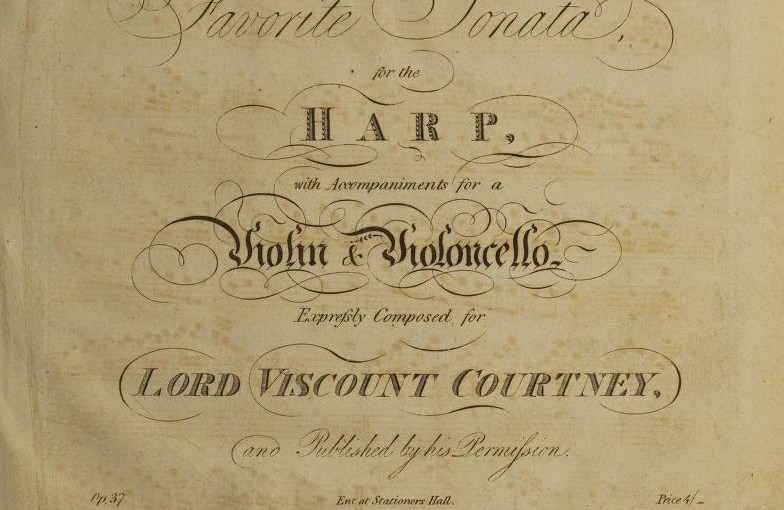
- 1800 Printed and sold by Rt. Birchall, at his Musical Circulating Library, 133 New-bond-street (London, England):
‘Dussek’s Favorite Sonata for the Harp with Accompaniments for a Violin & Violoncello — Expressly Composed for Lord Viscount Courtney and Published by his Permission’.
- 1800 Exeter Flying Post, August 14:
Exeter, Wednesday, Aug. 13. | […] Yesterday the prizes given by the Right Hon. Lord Viscount Courtenay were sailed for on the River Exe, in front of Powderham Castle. […] His Lordhip embarked on board his elegant barge about half past-ten, accmpanied by another barge having a band of music on board. A cannon was immediately fired — the band struck up “God save the King,” and the boats got under weigh, forming a beautiful and picturesque appearance, highly gratifying to a large concourse of spectators, who attended on the occasion.
- 1801 Oracle, and Daily Advertiser, April 9:
Lord Courtenay’s Concert, on Sunday next, promises to be very numerously attended. Among others, however, it is doubtful whether Mr. B ******* will attend.
- 1801 Morning Post, April 13:
Lord Courtney had a grand Concert last night at his house in Grosvenor-square. Many distinguished Personages were present, and among the Professional Gentlemen were the Leanders, &c.
- 1801 Morning Chronicle, Tuesday April 14, p.3:
Lord Courtenay gave a grand Concert on Sunday night, at which a number of the first performers assisted, among whom were Viganoni and Morelli, as well as Signora Bolla, who, though she directed her principal song to be cut out of the Opera on Saturday night, to the disappointment of the audience, under the score of utter inability to go through the whole of the part from indisposition, found herself well enough to sing the next night at this crowded assembly!
- 1801 Morning Herald, Tuesday April 14, p.2:
Madame Bolla emitted a considerable part of the music of the Opera at the King’s Theatre, on Saturday evening. This circumstance was considered as arising entirely from indisposition, though it has since been stated, that she sung on the following evening at Lord Courteney’s Concert. We hope that this report is not correct; and we shall be exceedingly happy to be afforded an opportunity of contradicting it.
- 1801 Morning Post, May 2:
Fashionable Arrangements For The Week | Sunday. | Lady Broughton’s grand Dinner, Stable-yard, St. James’s. | Mr. O’Byrne’s grand Dinner, Clarges-street. | Countess of Kenmare’s Party. | Viscount Courtenay’s Concert.
- 1801 Morning Post, September 30:
Lord Courteney’s concerts at Powderham are conducted on a very superior scale; the parties are select, being almost wholly composed of musical amateurs residing in the neighbourhood of the Castle.
- 1802 Exeter Flying Post, January 21:
Under the Patronage of the Right Honorable Lord Viscount Courtenay. | Mr. Pilbrow’s Concert, at the Hotel, January 21st, 1802. | Part 1st. | Overture, Haydn. | Duett, Mr. Paddon and Mrs. Margerum, “Ah ti lasoto!”, Gresnick. | New Concertante, Violin & Tenor Obligato, Pleyel. | Glee for 5 Voices, “Some of my Heroes are low”, Stevens. | Song, Mrs. Margerum, “Soft Zephyr,” Webbe. | Concerto, Piano Forte, Mr. Pilbrow, Krumpholtz. | Part 2d. | Concerto Violin, Mr. Hutton, Giornovick | Glee, “O Delia how divinely bright!” By a Nobleman. | Song, Mrs. Margerum, “Resta ingrata!” Sacchini. | Concerto Clarionet, Mr. Dale, Mahoon. | Trio, “Listen, no, it is the Owl,” Storace. | Overture, Shield. | Leader of the Band Mr. Hutton | To begin at Seven o’Clock. | Tickets 3s 6d. each, to be had at Messrs. Trewmans; Mr. Hedgeland’s, Stationer; Mol’s Coffee-House; and at the Hotel. | Exeter, January 12th, 1802.
- 1802 Exeter Flying Post, January 28:
Pilbrow’s Concert on Thursday last, under the auspices of the Right. Hon. Lord Courtenay, was attended by a most respectable audience. Mrs. Margerum‘s singing was excellent, she was encored in that fine song of Sacchini’s — Resta ingrata— in which she displayed the happiest union of taste, stile, and pathos. — The Glees were no less distinguished for correct execution and professional merit; and the audience felt much gratified by the chaste animation and judicious manner of Mr. Paddon in the beautiful Duet of — A[???], bene amato. — Mr. Pilbrow performed his Concerto on the Piano Forte en vrai claveciniste, and so completely possessed the idea of the subject, that we were equally impressed with the merit of the execution, as with that of the composition, which were perfectly d’accord. — Mr. Hutton‘s Violin Concerto was much and deservedly applauded; it seemed to have a fortunate interest in the agreeable melange of the evening: in short, the whole orchestra was happy in the approbation of a polite audience, composed of genuine taste and elegance.
- 1802 Times, May 31:
Lord Courtney’s first Sunday Concert was given yesterday evening, at which were present a large party of the Nobility.
- 1802 Exeter Flying Post, July 29:
Thursday last the Prizes given by the Right Hon. Lord Viscount Courtenay were sailed for on the River Exe, fronting Powderham Castle; […] A very large assemblage of company, in carriages, on horses, and pedestrians, lined the shore on each side. The elegant yachts of his Lordship were dressed in their colours, and a band of music played therein during the contest. His Lordship embarked on board his twelve oar’d barge about half past eleven, and the signal gun was fired immediately after, for the boats to get under weigh. The weather being very favourable, the number of pleasure boats on the river, and the spectators who crowded its banks, gave the whole a very picturesque and pleasing appearance.
- 1802 Sun, December 27:
It is stated in an account from Exeter, that the first meeting of the Harmonic Society, which took place a few evenings ago, was extremely well attended. Several people of consequence were present, and among others, Lord and Lady Clifford, Lord Graves, Lady Park, Sir L. and Lady Northcote, Sir J. and Lady Davy, &c. &c.; all the principal families within ten miles of Exeter were present, as well as the dignified Clergy of the Cathedral, and a number of Merchants, Counsellors, and Professional Gentlemen. The evening would have passed with real harmony, had it not been for an unfortunate disturbance which originated in the conduct of the Lord C———y. His Lordship, on taking a survey of the company, was pleased to think they were, in general, not fit to associate with people of title, and insisted on being separated from them by having chairs placed at the head of the room, instead of the forms which had been prepared for the whole of the visitors; he broke through the first article which had been entered into by the subscribers, and behaved in such a manner as to call forth the animadversion of Counsellor Tonkin, one of the stewards. A dispute took place, which ended in his Lordship recalling some disrespectful expressions he had used, and immediately retiring with his sisters from the room. After the entertainment the Committee sat, and returned thanks to Counsellor T. for his spirited conduct. They also came to the resolution of transmitting his Lordship’s subscription-money to him by the post.
- 1802 Bury and Norwich Post, December 29:
Lord C — T — Y riding the High Horse. | — The first Harmonic Meeting at Exeter was very numerously attended by the Nobility and people of fashion, though it did not conclude without some discord. — A noble Lord thought that people of his rank should be distinguished from the inferior gentry, and insisted on being separated from them by having chairs placed at the head of the room, instead of the forms which had been prepared for the whole of the visitors; he behaved in such a manner as to call forth the animadversions of Counsellor Tonkin, one of the Stewards. A dispute took place, which ended in his Lordship recalling some disrespectful expressions he had used, and immediately retiring with his sisters from the room. After the entertainment the Committee sat, and returned thanks to Counsellor T. for his spirited conduct. They also came to the resolution of transmitting his Lordship’s subscription money to him by the post.
- 1802 Exeter Flying Post, December 30:
Exeter Harmonic Society. | The third meeting will be on Thursday January the Sixth, 1803, at the Hotel Assembly Room. | Dr. Parr and Mr. Hubert Cornish, Stewards. | Mr. Paddon, Conductor. | To prevent Disappointment, the Music will commence precisely at Half past Seven o’Clock.
- 1803 True Briton, January 4:
Lord Courtenay, it seems, is making great preparations for a magnificent Gala at Powderham Castle. We do not hear that his Lordship has sent an invitation to Counsellor Tonkin.
- 1803 Morning Post, January 4:
Lord Courtenay intends complaining to the House of Lords against the Harmonic Society Exeter, for a breach of privilege, in not allowing him an elbow chair.
- 1804 The Sporting Magazine, October, p.34 [The ‘sister Sylphs‘ were probably Caroline, Sophia and Louisa Courtenay, the last three of William’s sisters to marry.]:
having a recommendation to view the internal beauties of this celebrated mansion, I presently entered Powderham castle. […] While I was here, I had a transient view of the three sister Sylphs of the castle; the first, like St. Cecilia, was playing on her harp: the second, like Ariel, singing to the divine harmony of the chords; and the third, like Penelope, employed in adorning the web of the loom.
- 1805 Western Flying Post, July 22:
The concert at Exeter Theatre on the 12th instant, performed for the benefit of the Devon and Exeter Hospital, was numerously and genteelly attended and gave very general satisfaction. Lord Viscount Courtenay paid the handsome sum of one hundred guineas for the admission of himself and his friends. After deducting all expences the sum paid by Mr. Paddon to the Treasurer of the hospital was 224l. 1s. which includes Lord Courtenay’s subscription.
- 1809 Morning Post, June 12:
Fashionable Arrangements for the Week. | […] Friday. | Marchioness of Hertford’s Assembly, Manchester-square. | Lord Courtenay’s Concert, Portman-square. […]
- 1809 British Press, June 19:
Lord Courtenay’s Grand Concert. | His Lordship’s noble mansion, late the Duke of York’s, in Portman-square, was opened to the fashionable world, on Friday evening last, to above 300 persons of distinction. The rooms were most beautifully illuminated on the occasion, and refreshments, consisting, of all the delicacies of the season, liberally provided. The Concert consisted of some of the first talents that this country can boast; it commenced with a fine Overture of Beethoven. Madame Collini, Miss Hughes, and Signors Naldi, Sisoni, and Rovedino, executed several delightful songs, duets, terzettos, and quartets. Spagnoletti, the Leanders, Holmes, Lindley, &c. played solos on their respective instruments. Among the company we noticed — | The Duke of Cambridge, Duke and Duchess of Beaufort, and Dowager of Beaufort, the Ladies Somerset, Lord C. Somerset and Lady; Ladies Heathcote, Manners, Templetown, Lemon, and Honywood; Lords Templetown, Maynard, &c.
- 1810 Morning Chronicle, May 3:
Lord Courtenay’s grand concert is fixed for Thursday next, at his house in Portman-square.
- 1810 Morning Post, May 14:
Fashionable arrangements for the week. | […] Friday. | Lord Courtenay’s Concert, Portman-square.
- 1823 Morning Chronicle, October 7:
Splendid Sale at Powderham Castle. | Mr. E. Carter respectfully announces, that on Monday, the 20th instant, precisely at Twelve at noon, will commence an Auction for the Sale of the | Magnificent Furniture of Powderham Castle; | Consisting of superb state beds, with rich satin hangings, handsome dome tester and other beds, with chintz and printed cotton draperies, excellent feather beds, mattresses, blankets, &c. &c. with satin wood and mahogany wardrobes, toilettes, chairs, cabinets, and other furniture, adapted to the style of each respective apartment, cheval glasses, &c. &c. In the Music-room, Drawing-room, and Parlours, are finely carved and gilded sofas, couches, chairs, and table; curtains, draperies, and carpets of the richest materials and best manufacture; superb cut-glass chandeliers and lustres, of the most elegant forms that a tasteful arrangement of a beautiful material can produce; together with grand and square piano-fortes, by Broadwood.
- 1833 Morning Post, December 31:
New Musical Instrument. | Mr. Niggl has brought from Germany a pianoforte with two sets of keys; the lower set is the same as that on every other instrument of the kind, and the same effect is produced; but the upper keys, when touched, produce tones resembling stringed instruments, and very similar in effect to violins with mutes on; and when notes are sustained they resemble those called harmonics on stringed instruments, or the higher tones of a flageolet. The melody is played by the right hand on the upper keys, while an accompaniment is performed by the left on the lower ones. In this respect this instrument has the advantage over those made by Mott, and the combined effect is very pleasing and novel. There was an instrument, some thirty years ago, at Powderham Castle, which produced very similar tones to the upper ones on this, but that was an upright pianoforte — this is an horizontal one. A select number of musical professors and amateurs attended a private exhibition of Mr. Niggl’s pianoforte yesterday morning, at No. 8, Rathbone-place, who appeared pleased with it; and it is but justice to say that the Gentleman who performed on it displayed much taste and talent.
Image

- Jan Ladislav Dussek, Op. 37, ‘Favorite Sonata for the Harp with Accompaniments for a Violin & Violoncello – Expressly Composed for Lord Viscount Courtney and Published by his Permission’. Published London, 1800.
https://archive.org/details/dusseksfavorites01duss
Page history
- 2023 December 19: first published online
- 2024 January 5: 1802-1803 Exeter Harmonic Society items added.
- 2024 January 29: 1794 Dorothy Presswell item added.
- 2024 April 11: 1794 The exiled earl, additional information about William’s theatre box.
- 2025 May 13: 1790, Kentish Gazette 6 August added
- 2025 May 16: 1801, Morning Chronicle 14 April & Morning Herald 14 April added
- 2025 June 10: 1791, Music and dancing added.
- 2025 September 10: 1778, Trewman’s Exeter Flying Post added.
 William Courtenay (1768-1835)