[This note will be developed more fully later.]
Exeter – Teignmouth – London – Powderham
EXETER
- 1787 Bath Chronicle, 18 October 1787:
Exeter, Oct. 10. This evening was opened for the first time, the New Theatre in the Circus, with The Belle’s Stratagem, and Bon Ton, being by desire of Lord Viscount Courtenay [William’s father]. — The Stile in which this Theatre is decorated, is vastly superior to any thing that has been hitherto represented in the West. — The scenery is new, and was partly executed by Mr. Carver, scene-painter to Covent-garden theatre, and presented to the proprietors by Lord V. Courtenay; the remainder was the performance of Mr. Phillips, assistant to Mr. French of Bath, and Mr. Hughes the manager.
- 1787 Trewman’s Exeter Flying Post, 25 October 1787:
[opening night of New Theatre in Exeter, October 10] the audience was very large and brilliant, and testified their approbation of the elegance of the house by a continual applause, the front was illuminated with wax which added much to the lustre of the appearance […]
- 1787 William Cotton, The story of the drama in Exeter, during its best period, 1787-1823, 1887, pp.2-4 :
At the time of which we are speaking, there was a marked intellectual activity in Exeter society, the outcome of which was a recognition of the power of the stage and a desire to elevate and purify the drama. It was felt that the acting should be brought up to a nearer level with the language and design of the various authors, and that the drama should have a home worthy of its position. So it came about that Mr. Hughes, of Birmingham, a man well-known in the theatrical world and a friend of the famous Sarah Siddons, came to Exeter, and, in conjunction with Mr. Trewman, built the second theatre on the site in Bedford Circus. | On the 10th October, 1787 , the new theatre was opened for the first time, under the patronage of Lord Viscount Courtenay [William’s father]. It was looked upon as a great event in the annals of the city, and all were anxious to recognize the public spirit of the managers, and to give a hearty support to their enterprize. It is scarcely necessary to say that every seat was taken in advance, and many more were applied for than could be allotted. The exterior of the building was illuminated with wax candles which, we are told, added much to the lustre of its appearance. The doors were opened at half-past five o’clock, when the pit and gallery were at once filled with a rush, and soon after arrived the first sedan chair and deposited its precious burden at the entrance. A continuous stream of arrivals soon blocked up the crush room, and the gossip, chatter, and congratulations had reached their height-for everyone knew each other in those days – when a move was made to the circle. The first who entered were struck with admiration at the beauty of the house, and could not restrain their applause; the second batch followed suit, and so on until the house was filled to overflowing. When all were comfortably seated as doubtless they would be, seeing that the female costume of the period required no great space beyond natural limits – the green curtain was drawn up and revealed the drop scene, whereat there was more applause. Then the music struck up and soon we come to Mr. Hughes’ prologue, specially written for the occasion, in which occur the following lines:—
From a small stage for scenery most unfit
From shapeless boxes and an awkward pit,
Long dark approaches, passages confined,
And walls whose crannies wooed the passing wind,
With joy sincere our generous friends we greet
On boards where we have room to move our feet.
The play selected was Mrs. Cowley’s charming comedy of The Belle’s Stratagem, and the farce was added of Bon Ton; or High Life above Stairs. The scenery, as it appeared from time to time, met with approving applause, and a brilliant evening came to a close as much to the satisfaction of the audience as the management.
- 1789 William Cotton, The story of the drama in Exeter, during its best period, 1787-1823, 1887, pp.7:
Mrs. Kemble took her benefit somewhat early in the season, under the patronage of the Hon. Miss Courtenay [Lucy, the eldest of William’s unmarried sisters], by whose desire was acted Steele’s comedy of The Conscious Lovers. The author’s principal intention in writing it was to introduce a very fine scene, which sets forth in a strong light the folly of duelling and the absurdity of what is called the point of honor. The scene concludes with these lines:
Betrayed by honor and compelled by shame,
They hazard being to preserve a name,
Nor dare enquire into the dread mistake,
Till, plunged in sad eternity, they wake!
It is not unlikely that some local affair of honor had taken place, which led to the choice of this play. A somewhat dangerous conclusion to the performance took the shape of a magnificent display of fireworks.
- 1801 Trewman’s Exeter Flying Post, 22 January 1801:
Exeter Theatre. | By desire of | The Right Hon. Lord Vis. Courtenay, | For the Benefit of Mr. Hughes. | On Friday, January the 23d, 1801, will be presented that excellent new Comedy, called | Life. | Now acting in the Theatre Royal, Covent Garden, with most uncommon Applause. […]
- 1804 Trewman’s Exeter Flying Post, Thursday 26 April 1804, p.4:
Exeter Theatre. | […] On Wednesday, | By Desire of the Right Hon. Lord Vis. Courtenay, | The Comedy of the Rivals. | With Entertainments.
- 1805 William Cotton, The story of the drama in Exeter, during its best period, 1787-1823, 1887, pp.21:
In 1805, the funds of the hospital appear to have been in very low water, and a vigorous and general effort was made to raise money, which was urgently needed in order to prevent the closing of some of the wards. The theatre was placed at the disposal of some gentlemen , who organized a concert on an unusually large scale, the proceeds of which were devoted to the charity. There were two military bands, the choir of Exeter Cathedral, and a large company of amateur and professional singers. It was rather a long performance, but then the prices of admission were high, and it cannot be said the audience had not enough for their money. The programme, too, showed a pleasing variety, which would keep up the attention. There were two overtures, five duets, one canzonet, one song, two trios, two recitatives with songs, three glees, two concertos of instruments, one quartette, and one double chorus; the performance being brought to a close with Handel’s Coronation Anthem. Most of the music was of a sacred character, but that was not considered more incongruous or profane than Catalani singing in a miscellaneous concert at the Cathedral and St Sidwell’s Church. Evidently, Lord Courtenay was quite satisfied with the arrangement, for he laid out £105 in places for himself and friends, the net sum handed over to the treasurer of the hospital being £224 2s.
- 1809 Trewman’s Exeter Flying Post, 23 February 1809:
Exeter Theatre. | By desire of | The Right Honorable Lord Viscount Courtenay. | On Friday evening, Feb. 21st, will be presented a new Comedy, in three acts, called | The School for Authors. | After which, a new comic Sketch, in one act, called | The Day after the Wedding; | Or, A Wife’s First Lesson. | To conclude with the Melo Drama of | The Tale of Mystery.
- 1809 Trewman’s Exeter Flying Post, 9 March 1809:
Exeter Theatre. | Under the Patronage and by Desire of The Honorable Miss Courtenay [William’s sister Caroline]. | For the Benefit of Miss Cherry. | On Friday evening, March 10th, will be presented the favorite Comedy of | Wild Oats; or, The Strolling Gentleman. | In the course of the evening (by particular desire,) The Bold Dragoon, by Mr. Rees. | For this night only, a Pas Seul, by Miss Cherry. | From the celebrated ballet dance, called the Scotch Ghost. | The favorite Song of Mr. O’Gallaher, | (Written by Mr. Cherry,) by Mr. Rees. | To conclude with a new musical Drama, (in two acts,) never performed here, called | The Young Hussar; or, Love and Mercy.
- 1810 Trewman’s Exeter Flying Post, 8 February 1810:
Winter Assemblies. | J. Phillips respectfully announces to the Nobility and Gentry of Exeter and its vicinity, that the next Assembly will be on Thursday the 15th February instant, and continue once a fortnight, during the season, when he trusts he shall receive that patronage which it will be his most anxious endeavour to merit. | Lady Edward Somerset, Patroness [William’s sister Louisa-Augusta]. | G. W. Bampfylde, esq. | Major Clay, Stewards. | Terms of Admission as usual. | Exeter, Hotel Assembly Room, Feb. 7, 1810.
Exeter Theatre. | By Desire of Lady Edward Somerset. | On Friday, Feb. 9th, 1810, will be presented the much-admired play of | The Foundling of the Forest. | With a Farce and Entertainments, | As will be expressed in the bills.
- 1810 Trewman’s Exeter Flying Post, 22 March 1810:
Exeter Theatre. | Under the Patronage of Lady Edward Somerset [William’s sister Louisa-Augusta]. | Flemmington’s Night. | On Tuesday, March 27th, 1810, will be presented Moreton’s Comedy of | The Way to Get Married. | A laughable Interlude, called My Grandmother. | A variety of Comic Songs. | To conclude with Coleman’s musical Farce of | The Review.
- 1820 William Cotton, The story of the drama in Exeter, during its best period, 1787-1823, 1887, pp.48:
The first week in March brought us the new comic opera of Rochester, or King Charles the Second’s Merry Days, which gave all the appearance of having a long run, but it was performed for the last time on the 7th March, 1820. In the early hours of the following morning the theatre, full of properties, machinery and combustible materials, caught fire and was completely destroyed, not a vestige of anything remaining; the conflagration being so fierce that the adjoining houses were with difficulty saved from destruction, and the whole building collapsed in less than half-an-hour.
TEIGNMOUTH
- 1802 Trewman’s Exeter Flying Post, 5 August 1802:
New Theatre, Teignmouth, Devon, | The Nobility, Gentry, and others, are respectfully informed, is now completely finished, and will open in the course of a Fortnight, under the Management of the Proprietor, Mr. Fisher, who assures his Friends, and the Public in general, he has engaged a Company of approved Abilities; and trusts, by a Production of the most recent and fashionable Pieces, to merit that Support he has hitherto so liberally experienced. | Teignmouth Theatre, Aug. 5th, 1802.
- 1802 Morning Post, Saturday 28 August 1802:
The new Teignmouth Theatre opens this night, under the patronage of Lord Courteney.
- 1802 Morning Post, 1 September 1802:
The new Teignmouth Theatre opened on Saturday, under the patronage of Lord Courteney.
- 1803 John Feltham, A guide to all the watering and sea-bathing places:
The theatre, built on a spot of ground given by Lord Courtenay, is fully adequate to the purpose for which it is intended. It will, no doubt, improve with the encouragement the manager receives.
- 1832 Samuel Tymms, The family topographer: the western circuit:
Teignmouth, theatre, handsome building, opened 1802;
LONDON
- 1794 Dorothy Presswell, The exiled earl, 2009, p.19:
[…] in 1794, Courtenay [William] leased ‘box number 70, in the first tier of boxes up one pair of stairs at the Kings Theatre in the Haymarket commonly called the Opera House, calculated to contain seven persons,’ at an annual rent of £210 after the initial payment of £262:10:0. [According to The plan of the boxes, published annually, William was leasing the same box until 1805. In 1797 and 1803 box 69 was held by lady Harewood and box 71 by the duchess of Marlborough. In 1804 box 69 had ‘six blanks’ but box 71 was leased by Georgiana duchess of Devonshire, with seats for her husband the duke of Devonshire, her friend and husband’s lover ‘lady Eliza Foster’, her sister Henrietta countess of Bessborough, her son-in-law George viscount Morpeth, and Granville Leveson-Gower, Henrietta’s lover who later married Georgiana’s younger daughter. In 1805 the neighbouring boxes on either side were leased by viscountess Villiers, a celebrated hostess nicknamed Silence and remembered by her later title as lady Jersey. By 1807 none of these three boxes was leased and William’s name does not appear in the list of subscribers.]
- 1805 Bedfordshire Archives: letters from Mary dowager lady Grantham to another widow, her sister-in-law Katherine Gertrude Robinson.
September 10: She has notified Monk that she wishes to take Lord Courtenay’s box, for 200 guineas for the season. | September 22: Lord Courtenay has agreed to lease his theatre box, however he did not mention where the money should be paid. | September 30: Refers to the theatre box, and that they must allow Lord Courtenay to use it when he visits London.
POWDERHAM
- 1805 Morning Post, 24 October 1805:
A most superb Theatre has been fitted up at Powderham Castle in Devonshire, the seat of Lord Viscount Courtenay, where, for these three weeks, a dramatic company has been performing. On Wednesday last, the comedy of The Provoked Husband was represented, in which Mr. and Mrs. Clarke, late of the Exeter Theatre, filled the parts of Lord and Lady Townly with great ability. A ballet dance called Laura and Lenza followed; the principal characters were sustained by Lord Courtenay, Lord Edward Somerset, the Hon. Miss Courtenay [William’s sister Caroline-Eustatia], Miss Louisa Courtenay (now Lady Edward Somerset), Miss Bamfylde, Miss Honeywood, and a number of other fashionables. The scenery is beautiful in the extreme, and the dresses and decorations are tasteful and magnificent.
- 1805 Globe, 23 October 1805:
Powderham Castle Theatricals. | A most superb Theatre has been fitted up at Powderham Castle in Devonshire, […] The scenery is beautiful in the extreme, and the dresses and decorations are such as the well-known taste and magnificence of the Viscount and the ladies might be expected to dictate. Powderham Castle has long been the seat of the most refined and elegant manners.
- 1805 Dorothy Presswell, The exiled earl, 2009, p.19:
In the [Powderham] accounts for 1805, Mr M J Hollogan of Covent Garden Theatre was paid £210 for scene painting for his Lordship’s Theatre at Powderham […]
- 180[?] Dorothy Presswell, The exiled earl, 2009, p.41:
The bills [from ‘the Kenton shoemaker, Staffick’] totalled nearly £600 and according to the shoemaker, related in the most part to shoes provided for the theatre at Powderham. […] His Lordship [William] wrote to say that the strolling players must have taken advantage of his foolish liberality because he, himself, had never ordered a pair of shoes for the theatre in his life.
- 1809 Royal Cornwall Gazette, 11 November 1809:
Among the innumerate acts of beneficence, on the late Jubilee [of king George III], a twentieth part of which will never be reported, Lord Courtenay, gave the following sums to the poor of his neighbourhood: — To the parish of Kenton, 50l.; Powderham, 25l.; Exminster, 5l. 5s. and Alphington, 5I. 5s. His Lordship’s Belvidere was brilliantly illuminated; and the elegant Theatre at Powderham was opened on that night for the free admission of the public, his Lordship performing a principal part in play and farce!
- 1811 Dorothy Presswell, The exiled earl, 2009, p.19:
[…] an inventory of the contents of the theatrical wardrobe dated 11 July 1811 records a splendid array of over 140 costumes and props including 92 stuff jackets and trousers; 23 scarlet and black caps; 12 stuff jackets, trousers and aprons of different colours for children; 9 dress coats (various colours); a hoop and blue petticoat covered with white muslin and trimmed with flowers; a fine smocked frock; jacket and trousers, belt and beard (Robinson Crusoe’s dress); an elegant Robinson Crusoe’s hat; a crimson velvet cloak lined with white silk; a livery coat and belt belonging to St James’s (Beefeaters); harlequin jacket and band; devil’s dress consisting of 17 articles; freemason’s apron; a complete suit of armour; 2 prison chains; 6 wigs; 14 feathers; a pair of stays.
- 1811 Trewman’s Exeter Flying Post, 18 July 1811:
Powderham Theatre. | To be Sold by auction, by Carter and Son, on Tuesday the 23d instant, on the premises, at the Theatre, Powderham, all the Scenery, Machinery, and other Articles belonging thereto. | Particulars, descriptive of the whole, may be had of the auctioneer a week before the sale; and for viewing, application is to be made to Mr. Thomas Gardener, in Powderham-street. | Dated High-street, Exeter, 3d July, 1811.
Image
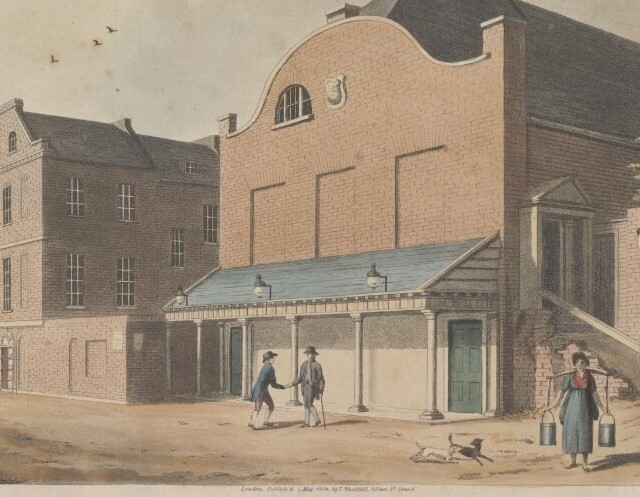
- Exeter theatre, published London, 1804, by T. Woodfall.
https://collections.vam.ac.uk/item/O182088/h-beard-print-collection-print-woodfall-t/
Page history
- 2024 January 3: first published online.
- 2024 January 5: 1809 item added.
- 2024 January 21: four items from Dorothy Presswell added — London 1794 and three to Powderham.
- 2024 February 8: 1787, item from Exeter Flying Post added.
- 2024 February 16: 1809, March, item from Exeter Flying Post added.
- 2024 April 11: London 1794, additional information about William’s theatre box.
- 2025 August 17: Exeter 1804, item from Trewman’s Exeter Flying Post added.
 William Courtenay (1768-1835)