
In April 1794 the British parliament passed an act ‘for encouraging and disciplining such corps or companies of men, as shall voluntarily inroll themselves for the defence of their counties, towns, or coasts, or for the general defence of the kingdom, during the present war.’ Britain had been at war with the republic of France since February 1793, a conflict that was to continue until 1815 with intervals in 1802 and 1814.
The Kenton Volunteers were among the new associations brought into existence by the act of 1794. William presented them with new ‘colours’ in the following year and became major of the corps in 1801 after the death of Richard Rose Drewe.
By January 1802 the Kenton corps had been amalgamated with others in the area to form the Loyal Exminster Hundred Regiment of Volunteers. (The hundred was an old administrative grouping of parishes and division of counties. In Devon, Exminster hundred reached northwards as far as the village of Ide and southwards beyond Powderham down to Dawlish and Teignmouth on the coast.) The War-office appointed William as lieutenant-colonel commandant of this infantry regiment and William Rainforth, an experienced army officer, as major. The Exminster corps was still active in June 1808.
~~~~~~~~~~~~~~~~~~~~~~~~~~~~
- 1794 Diary of queen Charlotte, Wednesday 17 September 1794 at Weymouth (Dorset, England); published in Memoirs of the court of George III, ed. Michael Kassler, 2015, vol. 4 p.261:
We saw to Day at Maiden Camp some of the Exminster Volunteers Their Uniform is Blue & Yellow & Silver, & their Caps or Helmets Black with Scarlet Ribbons & Feathers. | I saw Mrs Damer also at Maiden Camp.
- 1795 Gentleman’s Magazine, January 1795, vol. 65 part 1 pp.77-78:
Jan. 19. On Monday last, being the day appointed to celebrate the Queen’s Birthday, the Kenton Volunteers assembled in the morning, at their usual parade, to receive a
new Colour, given by the Right Hon. Lord Viscount Courtenay. Having gone through
various evolutions in a steady and soldier-like manner, they received the colour; and from thence proceeded to church, where it was consecrated by the Rev. W. F. Mackenzie. They then marched to a field adjoining the church, where they fired three excellent vollies in honour of the day; after which they proceeded to Powderham-Castle, and having again fired in a manner which gave universal satisfaction, and reflected high honour on themselves and their officers, his Lordship was then thanked by their Commander, for the high honour conferred on them that day. Being regaled at the Castle, they retired to the Courtenay Arms at Star-Cross, where a sumptuous dinner was provided at his Lordship’s expence, and concluded the evening with loyalty, harmony, and conviviality.
- 1795 Reading Mercury, Monday 8 June 1795, p.1:
London, Tuesday, June 2. […] Friday Capt. Babb’s Lady presented to the Newton-Bushel Volunteers the colours given by Lord Courtenay.
- 1795 Bath Chronicle, Thursday 11 June 1795, p.3:
The King’s Birth-Day. […] Same day the colours were delivered to the Honiton Volunteers, the gift of Lord Courtenay. | Same day the respective corps of Volunteers from Honiton, Sidmouth, Exeter, Cullompton, Exmouth, Kenton, Newton, and Sir Stafford Northcote’s troop of Light Dragoons, (in all about 800 men) were reviewed at Bicton park, by Col. Mackenzie. The concourse of spectators was immense, notwithstanding the heavy and incessant rain all the day; a line of more than 100 carriages was in the field.
- 1800 Western Flying Post, Monday 2 June 1800, p.3:
Honiton Independents. | The following Address from the Association under the command of Captain Carter, was at the Levee on Wednesday presented to his Majesty, by their respectable Representative, George Shum, Esq. | To the King’s Most Excellent Majesty. | “We your Majesty’s dutiful and loyal Independent Company of Volunteer Infantry, associated (under your Majesty’s sanction) for the protection of the borough and neighbourhood of Honiton, beg permission (in our civil capacity) humbly to approach your throne, to express our indignation at the recent atrocious and treasonable attack upon your Majesty’s sacred person, and to offer our most heartfelt congratulations to your Majesty for your happy escape from so imminent a danger. | “Attached by every sentiment of affection to your Majesty for the long-experienced blessings of your Majesty’s reign, and impressed with a due sense of those virtues so eminently displayed for the benefit of your subjects, we acknowledge, with all humility and gratitude, the interposition of Divine Providence, so signally exerted on this occasion, and offer up our fervent prayers that the same Providence will continue to watch over and preserve a life so dear to the country.”
[On the same day, Wednesday 28 May 1800, William presented another address from ‘the Portreeve, Bailiff, and principal Inhabitants of the Borough and Parish of Honiton’ who, ‘most humbly’, begged leave to express their ‘unfeigned and affectionate Congratulations on your Majesty’s providential Escape from the Attack which has been made upon your sacred Person, by the Hands of a desperate and vile Assassin.’]
- 1801 Oracle and Daily Advertiser, Monday 28 September 1801, p.3:
Last week there was a Grand Sham-Fight and Review on Woodbury Common, near Exeter, before Generals England, Simcoe, Don, and Horneck. — The following Troops were on the ground, and engaged in this business; three troops of the 6th or Enniskillen Dragoons; the First Devon, two troops, Tiverton, Collumpton, two Woodbury troops, Exeter City Troop, and Hemyock Troop of Volunteer Cavalry; the South Devon, Royal Denbigh, and Carmarthen Militias; the Exeter Volunteer Regiment; the Exmouth, Sidmouth, Lympston, Kenton, and Powderham, Exminster, Beer, and Seaton, &c. &c. Corps of Volunteer Infantry; making in all a body of full 4000 effective men, including 600 cavalry, all of whom received the thanks of the Generals for their steadiness and attention to the business of the day.
- 1801 London Chronicle, Tuesday 20 October 1801, p.6:
Extract of a Letter from Exeter, Oct. 15. | “Yesterday evening, at seven o’clock, nearly all the Military Corps in this district were assembled on their different parades, to fire a triple feu-de-joie in celebration of the Peace so happily concluded between this Country, and France. Orders to this effect were issued by Lieut. Gen. Simcoe, and parties were stationed on different heights, so as to convey the signal for firing from one post to another, through the county. In consequence of which, two troops of the 6th, or Enniskillen Regiment of Dragoons, the Exeter City Troop of Volunteer Cavalry, the Royal Caermarthen Militia, the Exeter Volunteer Regiment of eight Companies, the 3d Corps of Exeter Volunteers, and the Exeter Volunteer Associated Regiment, were all assembled on Southernhay at the above hour, and being formed into a hollow square, the several Corps fired each a volley, and then a triple feu-de-joie, the Bands playing between the intervals ‘God save the King,’ ‘Rule Britannia,’ and ‘Britons strike home.’ | “The darkness of the evening added much to the beauty of the effect, produced by the quick fire from the musketry running through the ranks; while the drums beating a point of war, and the Bands of thc Regiments striking up those favourite national tunes, gave the whole a grand military appearance, truly novel , and pleasing. | “The signal for firing was conveyed by six long 24-pounders, which were placed on Haldown-hill, above five miles from Exeter, from whence also it was received by the Kenton and Powderham Corps, as well as by the Regiments encamped on Woodbury-hill, whose fires could be distinctly seen from the houses on Southernhay-place.”
- 1802 Exeter Flying Post, 14 January 1802, p.4:
Exeter, Wednesday Jan. 13. […] Yesterday being the Quarterly Mess of the Officers belonging to the several Volunteer Corps in this City and the Neighbourhood, Lord Viscount Courtenay, with his accustomed politeness, was pleased to send them a present of a fine Doe; on which occasion his Lordship received the thanks of a very large and respectable Company, who drank his health in sparkling bumpers of good old port.
- 1802 Auction Sale Prizes | Supplement to The Connoisseur, 1913, vol. 15 p.297:
[A silver medal for excellent shooting, either presented to or (more likely) awarded by the Exminster Volunteers.]
- 1803 Exeter Flying Post, Thursday 1 September 1803, p.1:
Devon. | The Names of the Deputy Lieutenants, appointed by the Lord Lieutenant, and approved of by his Majesty, to superintend the Hundreds and Divisions in the said County, under the Act of Parliament lately passed for enabling his Majesty more effectually to provide for the Defence of the Realm during the present War, &c. | […] Hundred of Exminster, (exclusive of the Parish of Chudleigh,) — Right Hon. Lord Courtenay, and Sir Lawrence Palk, Bart.
- 1803 List of the Volunteer and Yeomanry Corps of the United Kingdom, 1804, p. 18:
[In August 1803 the Westminster House of Commons ordered a count of the volunteer and yeomanry corps in Great Britain and Ireland. The returns of December 1803 formed the basis of this list printed in 1804. The total of rank and file volunteers in Great Britain was 342,060 with 15,212 volunteers in Devon. The list recorded: Volunteers, Commandant, Effective Rank & File.]
Exminster, Lord Courtenay, 345.
- 1804 Exeter Flying Post, Thursday 5 January 1804, p.4:
Monday last the Exeter Volunteer regiment, with the First Somerset Militia, the Royal Miners, a detachment of the 10th regiment of reserve, a squadron of the Royal Dragoon Guards, the Exeter Artillery, and Artificer’s Corps, attended by their field-pieces, were brigaded on Haldon, where they were met by Lord Clifford’s squadron of yeomanry cavalry, Lord Courtenay’s regiment of Volunteer Infantry, the Chudleigh volunteers, and the light company of the Second Somerset. — The business commenced by an attack on a strong position, at the entrance of Haldon, on the Newton road, which was difficult of access, and strengthened by artillery; the light troops having, however, driven in the advanced posts, and the sharp-shooters thrown out to annoy them, the artillery, &c. retreated towards the Race Stands, where they were vigorously pursued by the attacking army. The firing was kept up on each side with great vivacity, and different positions were taken to show the manner of forming, in case of actual service; after which the whole body were marched into line, several feus de joie were fired from centre to flanks, after which the cavalry, drawn up on the right wing, advanced and charged, when the business concluded. The day (tho’ cold) was remarkably fine, and the troops, advancing to the attack amidst the roar of artillery and musquetry, had a brilliant effect, and afforded a high gratification to every spectator. Lieut. General Simcoe and Brigadier General Gower, were present, and commanded the troops on this occasion.
- 1804 Courier, Tuesday 10 January 1804, p.3:
Last week the Volunteers of Exeter were brigaded with the King’s Dragoon Guards; they together assembled to the amount of 4000 men, and repaired to Halldon, where they were met by General Simcoe. He expressed in high terms the forward state of the Volunteers; at the same time observed, that their being brigaded with the line was the surest way to arrive at perfection.
- 1804 Sun, Saturday 28 January 1804, p.4:
Monday last the Exeter Volunteer Regiment were brigaded with a squadron of the Royal Dragoon Guards, the First Somerset Militia, the Royal Miners, and a strong body of Artillery. They marched from Exeter about nine o’clock, to Countess-wear bridge, where the operations commenced: the bridge was defended by some pieces of artillery, and a detachment of the 10th Regiment of Reserve. Being, however, driven from their position, they retreated towards the main body at Powderham, skirmishing occasionally with the advanced guard. On their arrival at the plantations of Powderham, the grand attack was made on the main body, consisting of Lord Viscount Courtenay’s Regiment of Exminster Volunteers and a detachment of the 10th Regiment of Reserve, drawn up in an advantageous position, and defended by several pieces of heavy artillery — the adjoining woods being well secured by bodies of light troops. The attacking Army having formed, advanced in column to the front, whilst the flank companies defiling through the woods, made an attack on the enemy’s left, and the artillery kept their right in check. The operations now had a most pleasing effect, from the continued skirmishing of the light troops in the woods, the one party retreating as the other advanced, and disputing with their opponents every inch of ground, of which the plantations gave them an ample opportunity. The firing was occasionally vivid and general, — then a moment’s pause, until the retreating party had gained a fresh covert to contest, when it became again incessant, insomuch as to exhibit all the manœuvres of a battle, with the most pleasing effect to the eye of the spectator. After long contesting the ground through Powderham Plantations, the Army on the defensive retreated to the Belvidere, where being followed by their assailants, and the skirmishers being driven in, the business of the day terminated. — A feu-de-joie was then fired by the whole line, when the troops returned to their respective quarters, after going through a variety of manœuvres particularly instructive to them in case of real service, as its appearance was gratifying to a large number of spectators.
- 1804 Royal Cornwall Gazette, Saturday 18 February 1804, p.2:
Monday last three troops of the Royal First Devon Cavalry; Lord Clifford’s squadron of Yeomanry Cavalry; and the Exeter and Exminster Volunteer Regiments, were brigaded with a squadron of the Royal Dragoon Guards, the Royal Miners and First Somerset Regiments, a detachment of the 10th. Reserve, the light companies of the North Devon and Second Somerset, aided by a detachment of Artillery, and several field pieces. — The operations commenced at the village of Exminster, which was attacked by the Militia and Dragoon Guards, and defended by the Volunteer corps and light troops, who, at length retreated, disputing the different positions from thence to Powderham woods, which were also forced — the retreating army then fell back to the Belvidere, where the business terminated. The favourable weather (although very cold) attracted vast number of spectators, who were highly gratified by the manœuvres displayed the troops on this occasion. — The troops marched from Exeter at nine in the morning, and did not return till about six in the evening, being under arms upwards of nine hours. Generals Simcoe and Gower were particularly pleased with the conduct of all the military, during the business of the day.
- 1804 Courier, Wednesday 22 February 1804, p.3:
Exeter, Feb. 14. | We yesterday witnessed one of the grandest military spectacles that ever has been displayed in the West; all the military were assembled, and marched towards Lord Courtney’s magnificent seat at Powderham; upon the road there was occasionally much firing, but it was very heavy as the troops approached the Belvedere. | At that time, the scene was truly grand, the whole extent of the beautiful park and woods was covered by lines of troops, and it was difficult for a spectator to decide whether he was most delighted with the science displayed in the arrangement of the troops, and the cool magnaminity with which the manœuvres were ordered, or with the display of female beauty and elegance which Exeter and its vicinity afforded to grace this scene. | We were at times much alarmed for some of our elegantés, who, eager to behold the traits of valour of their patriotic defenders, penetrated into the midst of the battle; they shewed much agility, but we feared, as the temptation was great, that they would have been made prisoners and carried off. | We observed no accident, except the fall of one of the Officers of Dragoons horse in a charge; he fortunately was not much hurt. | The troops returned to Exeter at six o’clock, and clearly proved by their conduct on that day, that if our boasting foe presumes to put in execution his vaunted threats, it will only add additional laurels to those already acquired by our patriotic defenders, and for which they so justly received the thanks of their King and of the Parliament.
- 1804 Exeter Flying Post, Thursday 24 May 1804, p.1:
To the Gentlemen, Freeholders, and Inhabitants, of the Hundred of Exminster. | May, 1804. | Whereas the Allowance granted from Government, to Volunteer Regiments, has been found by no means sufficient to defray the necessary expences, attending the raising and forming the Volunteer Regiment of the Hundred of Exminster; and the Officers, Non-commissioned Officers, and Privates having already given up some of their Pay, in order to defray the Expences of the said Regiment, which has been found to be by no means adequate to the Purpose. It is to be hoped that the Gentlemen of Landed Property, and inhabitants in the Hundred of Exminster, will come forward with their kind Assistance, in Support of the Regiment, which has been raised to protect their Property, their Families, and their very Existence. | Subscriptions Received. £. s. d. | Lieut. Col. the Rt. Hon. Lord Visc. Courtenay £50 0s. 0d. | Sir Laurance Palk, Bart. £40 0s. 0d. | Samuel Kekewich, Esq. £25 0s. 0d. | Philip Stowey. Esq. £10 10s. 0d. | Thomas John Taylor, Esq. £5 5s. 0d. | James Rollinson, Esq. £10 10s. 0d. | Patrick Lynch, Esq. £10 10s. 0d. | Subscriptions will be received at the Exeter Banks, and at Messrs. Trewman’s.
- 1805 Bath Journal, Monday 23 September 1805, p.4:
At three o’clock on Monday morning last the several regiments encamped on Woodbury hill, consisting of the Worcester, North Devon, Lancashire, and Bedford militias, with the horse artillery, struck their tents and marched from thence, for the purpose of forming a flying camp between that place and Plymouth; the Volunteer and other corps stationed in the intermediate places, near which they were to pass, were drawn out to harrass them on their march. On the first night (Monday) the flying camp pitched their tents on Haldon, and on their road thither were engaged in continual skirmishes with the small parties of troops stationed to impede their progress. On their arrival on Haldon they had to encounter the Exeter and Exminster regiments of volunteers, supported by some pieces of artillery, two squadrons of the 6th dragoon guards, and three troops of the royal first Devon cavalry. After some discharges of cannon and musquetry, and some false attacks by the cavalry on their flanks, whilst the infantry hung on their rear, the regiments composing the flying camp formed a square, to secure themselves and protect their baggage from further annoyance; after which they proceeded unmolested to the ground on which they were to encamp for the night. Yesterday they continued their march, encountering similar opposition from the country, to Ipplepen Common. This night (Wednesday) we understand, they encamp at Blackheath, near Morleigh; tomorrow (Thursday) they pitch their tents on a down near Ivy-bridge; Saturday on Ball Moore, near Plympton; and on Monday next an attack will be made upon the citadel at Plymouth, into which place the troops will endeavour to force a passage, but being defeated they are to retreat to Ball Moor, near Plympton, where they are to remain until the last week in October, during which, many sham fights are to take place. The number of troops encamped night, will be nearly four thousand. Those engaged in the business of Monday last, on Haldon, and in the skirmishes thither, amount to nearly six thousand. | Saturday and Sunday last two detachments of French prisoners were marched into Exeter from Plymouth, on their route to Stapleton, near Bristol, for which place they pursue their march to-morrow morning (Thursday).
- 1806 Western Times, Friday 21 October 1881, p.7:
Devonshire Volunteers. | To the Editor of The Daily Western Times. | Sir, — An interesting memorial of the premier Volunteer movement has recently come into possession of the Exeter and South Devon Rifle Volunteers. It consists of a roll showing the names of all Volunteer Corps existing in the year 1806. It also gives their effective strength and the names of the commanding officers. The total strength of the Volunteer force was — Artillery, 10,133; Cavalry, 31,771; Infantry, 328,956. The strength of the Engineers or Artificers, as they were then called, is not given. To this force Devonshire contributed — Engineers, 110; Artillery, 1,057; Cavalry, 1,487; Infantry, 14,949 — total, 17,603. […] A copy of the roll of the Devonshire Volunteers is attached. [The roll recorded: Name of Corps, Effective Strength, Commanding Officer.] Exminster Infantry, 404, Lt.-Col. Viscount Courtenay.
- 1808 Coventry Herald, Friday 17 June 1808, p.1:
A most ludicrous circumstance happened to the Loyal Exminster regiment of Volunteers, on His Majesty’s birth-day. The regiment having paraded in Powderham park, Devonshire, under the command of Major Rainsworth, received their ammunition, and were then marched on the hill near Lord Courtenay’s Belvidere for the purpose of firing three vollies, which should “make the welkin resound;” the muskets were primed and loaded – the word was given to make ready! – present! when one of the privates exclaimed, “Sir, we have got no flints!” On this an examination took place; and strange to relate, it was found that not a single man had a flint in his musket, the hammers being merely charged with a small piece of wood. What was to be done? The flints were locked up in store in the belvidere, the person who kept the key was not to be found, and the door could not be forced. Under these circumstances, the commanding officer thought proper to take the only step which prudence could dictate, and that was, to order every man to draw his cartridge, and throw the priming from the pan; which being done, the regiment then went thro’ the motions, and reserved the real fire for a future opportunity! [The substance of this text also appeared in The Sporting Magazine for June 1808: vol. 32 no. 189 p.129.]
~~~~~~~~~~~~~~~~~~~~~~~~~~~~
OFFICERS
William Rainforth was a professional soldier who had served as a British officer in north America. In Devon he lived at The Cot in Exminster (Western Flying Post, 3 December 1798, p.1) and later at Alphington where his wife Ann was buried in 1814 (their son had been baptised at Kenton in 1796). He himself was buried at Teignmouth in October 1837, aged 77. John Clack and his older brother William Charles Clack were younger cousins of William.
- 1794 Kentish Gazette, Friday 31 October 1794, p.2:
War-office, October 21. […] Kenton Volunteer Company. | Richard Rose Drewe, Esq. to be Captain. | John Bulkeley, Gent. to be First Lieut. | Nathaniel Ford, Gent. to be Second Lieut.
- 1797 Kentish Gazette, Tuesday 18 July 1797, p.2:
Promotions, from the London Gazette. […] War-office, July 8, 1797. […] Kenton Volunteers. | Captain Rich. Rose Drewe to be major commandant.
- 1798 The London Chronicle for 1798, vol. 82 p.443:
From the London Gazette of Oct. 2. […] Exminster Volunteers. — William Rainforth, Esq. to be Captain. Thomas Choron to be Ensign.
- 1801 Star, Wednesday 22 April 1801, p.2:
Kenton Volunteers. | The Right Hon. Lord Courtenay to be Major, vice Drewe, deceased.
- 1801 Star, Monday 28 September 1801, p.4:
From the London Gazette, Sept. 26. | Military Promotions. | […] Kenton Volunteers. | First Lieutenant James Bulkeley to be Captain. | Second Lieutenant Robert B. Howell to be First Lieutenant, vice Bulkeley. | Second Lieutenant William Collyns to be Ditto. | William Clack, Gent. to be Second Lieutenant, vice Howell. | John Clack, Gent. to be Ditto, vice Collyns.
- 1802 True Briton, Tuesday 19 January 1802, p.4:
From the London Gazette, Jan. 16, 1802 […] Loyal Exminster Hundred Regiment of Volunteers. | William Viscount Courtenay to be Lieutenant-Colonel-Commandant. William Rainsforth, Esq. to be Major.
- 1803 Sun, Saturday 16 July 1803, p.4:
From the London Gazette, July 12, 1803. […] Exminster Volunteers. | William Lord Viscount Courteney, to be Lieutenant-Colonel Commandant. William Rainforth, Esq. to be Major. | To be Captains — John Bulkeley, Esq. John Manley, Esq. William Henry Carrington, Esq. William Ley, Esq. James Bulkeley, Esq. William Ashe, Esq. | To be First Lieutenant — Robert B. Howell, Gent.
- 1803 Sun, Tuesday 13 September 1803, p.4:
From the London Gazette, Sept. 10, 1803. […] Exminster Volunteer Infantry. | William Rainforth, Gent. to be Adjutant.
Image
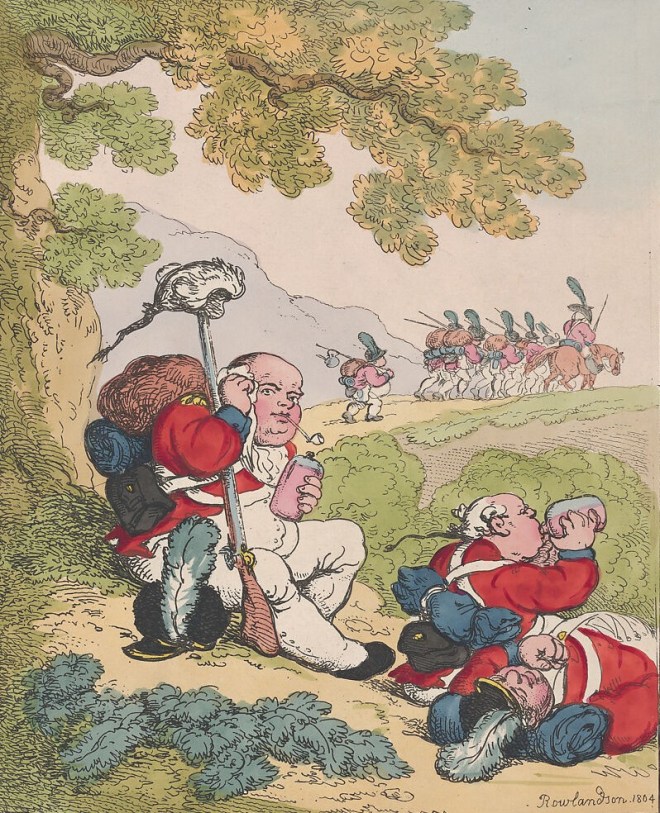
- Thomas Rowlandson, Light Infantry Volunteers on a March, 1804; © 2000–2025 The Metropolitan Museum of Art.
Page history
- 2025 December 7: first published online.
- 2025 December 21: Courier 10 January 1804 added.
 William Courtenay (1768-1835)