The first viscount Courtenay was William’s grandfather, sir William Courtenay. Sir William (he succeeded his father as a baronet in 1735) was a member of the Westminster House of Commons for 28 years from 1734, representing the borough of Honiton until 1741 and thereafter the county of Devon. In May 1762 the young king George III granted him a peerage as viscount Courtenay of Powderham Castle but the new nobleman died just ten days later. Although the House of Lords was meeting on several of those days in May, the first lord Courtenay did not take his seat in the upper chamber of the parliament of Great Britain.
William’s father, who was also named William, was 19 years of age when he succeeded to the hereditary peerage in 1762. He did not take his seat in the House of Lords until January 1765 (see below). The second viscount’s last attendance was a few days before his death in December 1788.
Like his father, William himself had not reached the legal age of majority when he became viscount Courtenay. After his twenty-first birthday he was presented to the king as the new viscount in August 1789 at Exeter. He took his seat in the House of Lords a few months later on Friday 12 March 1790 (see below). As a peer of Great Britain, he remained a member of parliament’s upper chamber in 1801 when the two kingdoms of Great Britain and Ireland were united.
William was neither a frequent nor a regular attender at parliament. In the twenty-one years before his exile began in 1811 he made no more than 57 attendances (listed below). He did not propose or second any motion, and it is quite possible that he never made a speech in the House during all that time.
There is no obvious pattern to William’s attendances. Apart from two days in October 1796, they all fell in the months February to June. He attended on twenty days in the four years 1790-1793, but then on only eighteen days in the longer period from 1795 to 1811. A third of his attendances happened in 1794 when William was present on nineteen days, noticeably more than the six or seven he managed in 1791 and 1793.
Perhaps in 1794 he was impelled by the political panic which at that time had taken possession of the British ruling class. On May 17 a bill to suspend the Habeas Corpus Act passed the House of Commons by 146 votes to 28. William was in attendance five days later when the House of Lords voted even more decisively in favour: 95 votes to 7. In both Houses the debate lasted until 3am. If he stayed so late, there can be little doubt that William like his uncle Loughborough would have voted with the majority of peers.
William’s aunt Charlotte Courtenay had married lord Loughborough in 1782 when he was Chief Justice of the Common Pleas. In January 1793 Loughborough was appointed Lord Chancellor; as such, he became a member of William Pitt’s Cabinet, with direct access to the king, and acted as Speaker of the House of Lords. In April 1801 he was obliged to resign his office, but at the same time was promoted in the peerage to be the first earl of Rosslyn.
After Rosslyn’s death in January 1804, William returned to parliament on only three occasions, the last of them on Monday 22 June 1807. By the time he left England in January 1811, viscount Courtenay had not appeared in the House of Lords for more than three years.
1811
The Regency Bill received its first reading in the House of Lords on Wednesday 23 January 1811, the day that William left England. Two months later he and William Fryer were indicted at the Devon Assizes on a charge of buggery but in June the earl of Radnor successfully proposed that the case should be transferred to the House of Lords.
Ordered, That the Bill of Indictment, found by the Grand Jury of the County of Devon at the last Assizes, against William Viscount Courtenay, for a Felony not Clergyable, be removed before this House, and that a Writ of Certiorari be issued under the Great Seal for that Purpose.
(Journals of the House of Lords, vol. 48, p.426; Tuesday 18 June 1811)
The House being informed, “that Mr. Follett, the Clerk of the Assizes of the Western Circuit, was attending, with the Certiorari, and the Bill of Indictment found by the Grand Jury of the County of Devon at the last Assizes against William Viscount Courtenay, and all Things touching the same;” | He was called in, and delivered the same at the Bar. | And being withdrawn; | The same were read by the Clerk.
(Journals of the House of Lords, vol. 48, p.472; Friday 12 July 1811)
That was the end of the legal proceedings: having removed matters from the Assizes, the House of Lords never considered them further.
1831
In 1830 William presented a petition to the king requesting, or rather “humbly praying” that “his Right to the Earldom of Devon may be recognized by His Majesty, and that he may be accordingly summoned to Parliament as Earl of Devon”. A few days before he died in June 1830, king George IV asked for a report from the Attorney General. In November the new king, William IV, referred both the petition and the Attorney General’s report to the House of Lords. In 1831 the Lords decided in favour of William’s claim.
Resolved and Adjudged, by the Lords Spiritual and Temporal in Parliament assembled, That William Viscount Courtenay hath made out his Claim to the Title, Honor and Dignity of Earl of Devon. | Ordered, That the said Resolution and Judgment be laid before his Majesty by the Lords with White Staves.
(Journals of the House of Lords, vol. 63, p.322; Monday 14 March 1831)
William remained viscount Courtenay after his claim to the earldom had been admitted, but the title became extinct at his death. He was third and last of the noble viscounts Courtenay: after May 1835 the style was no more than a courtesy title, first used for William-Reginald Courtenay who was to succeed his father as earl of Devon in 1859.
William’s father takes his seat in 1765
William, Viscount Courtenay, claiming by virtue of a Patent granted to his late Father William Viscount Courtenay, bearing date the 6th Day of May in the Second Year of his present Majesty, was this Day (in his Robes) introduced, between the Lord Viscount Weymouth and the Lord Viscount Bolingbroke (also in their Robes); the Gentleman Usher of the Black Rod, Garter King of Arms, the Deputy Earl Marshal, and the Lord Great Chamberlain of England, preceding. | His Lordship, on his Knee, presented the said Patent to the Lord Chancellor, at the Woolsack; who delivered it to the Clerk; and the same was read, at the Table. | His Writ of Summons was also read, as follows His Writ of Summons was also read, as follows: | “George the Third, by the Grace of God, of Great Britain, France, and Ireland, King, Defender of the Faith, and so forth; To Our Right Trusty and Well–beloved Cousin William Viscount Courtenay, Greeting. Whereas Our Parliament, for arduous and urgent Affairs, concerning Us, the State and Defence of Our Kingdom of Great Britain and the Church, is now met at Our City of Westminster; We, strictly enjoining, command you, under the Faith and Allegiance by which you are bound to Us, that, considering the Difficulty of the said Affairs, and Dangers impending, all Excuses being laid aside, you be personally present, at Our aforesaid Parliament, with Us, and with the Prelates, Nobles, and Peers, of Our said Kingdom, to treat of the aforesaid Affairs, and to give your Advice. And this you may in no wise omit, as you tender Us and Our Honour, and the Safety and Defence of the said Kingdom and Church, and the Dispatch of the said Affairs. | Witness Ourself, at Westminster, the Tenth Day of January in the Fifth Year of Our Reign. | Yorke & Yorke.” | Then his Lordship, at the Table, took the Oaths, and made and subscribed the Declaration, and also took and subscribed the Oath of Abjuration, pursuant to the Statutes; and was afterwards placed in his due Place, on the lower End of the Earls Bench.
(Journals of the House of Lords, vol. 31, p.5; Thursday 10 January 1765)
William takes his seat in 1790
This Day William Lord Viscount Courtenay sat first in Parliament after the Death of his Father William Lord Viscount Courtenay; his Lordship having first at the Table taken the Oaths, and made and subscribed the Declaration, and also taken and subscribed the Oath of Abjuration, pursuant to the Statutes. | Garter King at Arms delivered in at the Table his Lordship’s Pedigree, pursuant to the Standing Order.
(Journals of the House of Lords, vol. 38, p.563; Friday 12 March 1790)
William’s days of attendance at the House of Lords
- 1790 March 12; April 19; June 7.
- 1791 May 9, 13, 23, 27 & 31; June 2 & 3.
- 1792 February 17; April 5; May 22 & 23.
- 1793 February 1, 15, 18 & 27; May 24; June 21.
- 1794 February 14, 17, 25 & 27; March 1 & 27; April 9, 10, 28 & 29; May 2, 5, 6, 16, 17, 19, 20, 22 & 28.
- 1795 May 8; June 8.
- 1796 March 1; October 5 & 6.
- 1797 ~~~
- 1798 June 6
- 1799 ~~~
- 1800 April 28.
- 1801 February 16; March 20 & 31.
- 1802 ~~~
- 1803 April 22; May 10 & 23; June 1 & 20.
- 1804 ~~~
- 1805 May 10 & 13.
- 1806 ~~~
- 1807 June 22.
- 1808 ~~~
- 1809 ~~~
- 1810 ~~~
- 1811 ~~~
(information from the Journals of the House of Lords, volumes 38-48.)
Image
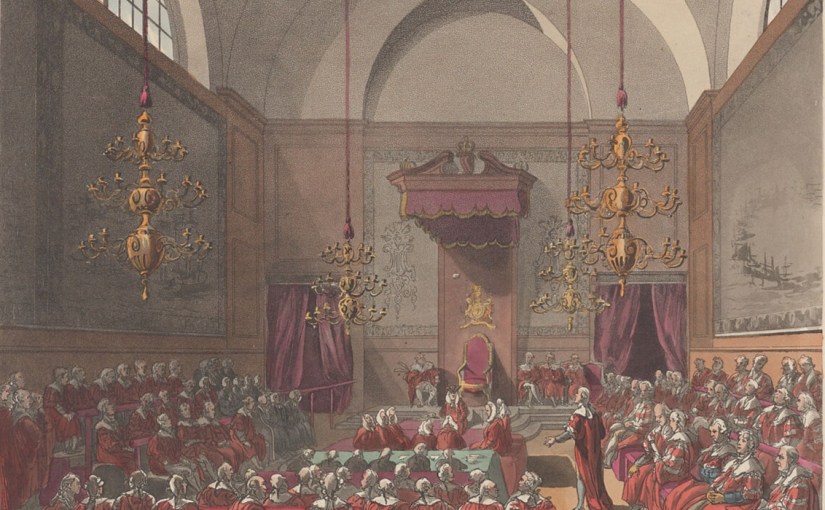
- Thomas Rowlandson & Auguste-Charles Pugin, House of Lords, aquatint by John Bluck, 1808, Metropolitan Museum of Art, New York. © 2000–2024 The Metropolitan Museum of Art.
The lords are pictured meeting in the Lesser Hall at the Palace of Westminster, a space used by the upper chamber of parliament after the Acts of Union from 1801 to 1834. The Lord Chancellor as speaker is seated in the centre below the throne, wearing a black tricorne hat.
Page history
- 2025 September 21: first published online.
 William Courtenay (1768-1835)