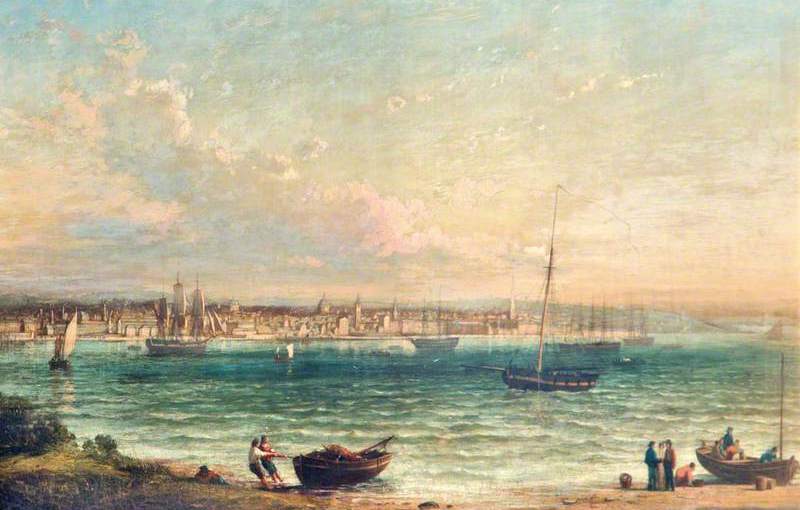
When a local magistrate began to investigate William’s sexual activities in Devon, he set off a train of events that led swiftly to the viscount’s departure from England and the long years of his exile in America and France. For several months in 1811 British newspapers printed stories about the affair, some of which are included here.
Many of those stories were untrue, in particular the popular notion that William had sailed from England in his yacht Dolphin. Later generations developed a further idea that William had fled because of his debts, preferring to ignore the fact that he was facing a capital charge of buggery. The indictment was preferred at the Devon assizes on Saturday 16 March 1811: ‘The Right Honourable William Lord Viscount Courtenay […] not having the fear of God before his eyes but being moved and seduced by the instigation of the Devil […] against the Order of nature had a venereal affair with the said William Fryer’ (full text below).
Dorothy Presswell retrieved key features of the true history for The Exiled Earl, published in 2009. As well as John Pidsley’s list of valuables from December 1810, she had discovered in her research the item in Trewman’s Exeter Flying Post of 6 June 1811. By ill luck, that paper had misprinted the name of the ship which carried William to America as June rather than Jane, and Presswell compounded this error by adding a captain’s name to that of the ship, writing of the ‘June Clark‘.
Although Clark commanded the American ship Jane on her return journey from New York to Plymouth later in 1811, it was a man named Gifford who was captain at the start of the year when William and his suite embarked at Liverpool. They sailed from England on Wednesday 23 January, arriving at New York on Friday 15 March. It’s evident from the 1812 register of enemy aliens in New York that William was accompanied by his cousin Edward-Robert Clack and at least two servants, George Woods and William Howe.
William Fryer, the second man named in the March indictment, did not resort to exile. Having left his job as a gardener at Powderham, he married Elizabeth Weeks in November 1810 at Exmouth where the first of their children was baptised in March 1811. Not long after his wife’s death in 1840 at Friern Barnet, William Fryer moved from that Middlesex village into London where he died in 1865 at Marylebone, aged 76. He received an annual pension from his former employer which was continued after 1835 by the terms of William’s will.
The magistrate whose ‘exertions’ brought about William’s exile was not named in the newspapers, but Joseph Farington’s diary refers to a ‘Mr. Morton’. This may be Charles Carr Morton (1773-1819) who was living near Powderham for several years around 1811.
Some of the newspaper items below relate to the contemporary punishment of other men for gay sex in England (prefixed o in the sequence of texts). For a good deal more material from such sources, see:
- Rictor Norton (Ed.), “Newspaper Reports, 1810“, Homosexuality in Nineteenth-Century England: A Sourcebook
- Rictor Norton (Ed.), “Newspaper Reports, 1811“, Homosexuality in Nineteenth-Century England: A Sourcebook
~~~~~~~~~~~~~~~~~~~~~~~~~~~~~~~~~
SEQUENCE OF TEXTS
1810
- October 10. Diary of Joseph Farington.
- November 20. Littleham & Exmouth register of marriages.
- December 29. Note of valuables returned to Powderham by John Pidsley.
1811
- January 7. Items in Times, Morning Post, Morning Herald, Public Ledger.
- January 8. Item in Morning Chronicle.
- January 9. Item in London Chronicle.
- January 10. Item in Morning Chronicle.
- January 11. Item in Morning Herald.
- January 12. Items in Morning Herald, Public Ledger. | Grant of annuity.
- January 13. Item in National Register. | Letter from Charles Skinner Matthews.
- January 14. Item in Salisbury & Winchester Journal.
- January 15. Items in General Evening Post, Morning Herald.
- January 16. Item in Morning Herald.
- January 17. Item in Morning Post.
- January 18. Item in Nottingham Review.
- January 19. Item in the Carlisle Journal.
- January 19. Item in the Morning Herald.
- January 20. Items in Johnson’s Sunday Monitor, News.
- January 21. Indenture of appointment and grant.
- January 22. Item in Chester Courant.
- January 23. William and his suite leave Liverpool for New York.
- January 24. Item in Taunton Courier.
- February 14. Item in Morning Herald.
- February 18. Item in Morning Post.
- February 23. Item in Public Ledger.
- February 25. Item in Morning Chronicle.
- February 28. Item in Trewman’s Exeter Flying Post.
- March 3. Item in Observer.
- March 7. Item in General Evening Post.
- March 9. Items in Morning Post, New York Evening Post.
- March 10. Littleham & Exmouth register of births and burials.
- March 14. Item in Trewman’s Exeter Flying Post.
- March 15. William and his suite arrive at New York from Liverpool.
- March 15. Item in New York Evening Post.
- March 16. Item in New York Evening Post. | Indictment at Devon Assizes.
- March 29. Item in Morning Herald.
- April 26. Item in Sun.
- April 30. Item in Morning Post.
- May 8. Letter from Percy Bysshe Shelley.
- May 17. Diary of Joseph Farington.
- May 18. Item in Globe.
- June 4. Item in Star
- June 5. Item in Pilot.
- June 6. Items in Trewman’s Exeter Flying Post, Bath Chronicle.
- June 11. Item in Morning Post.
- June 13. Item in Trewman’s Exeter Flying Post.
- June 14. Item in Globe.
- June 17. Item in Morning Post.
- June 18. Journals of the House of Lords.
- June 20. Item in Trewman’s Exeter Flying Post.
- July 12. Journals of the House of Lords.
- July 14. Bloomingdale register of marriages.
- September 16. Item in Morning Post.
- September 21. Item in Bristol Mirror.
- October 28. Item in Public Ledger.
1812
- July 25. Report on alien enemies in New York.

TEXTS
- 1810 Joseph Farington in his diary for Wednesday 10 October 1811. Thomas Yarde was a surgeon at Chudleigh (Devon) where Farington was staying.
Mr. Yard called in the evening and spoke of reports respecting Lord Courtenay which are daily becoming more particular. Many of the neighbouring gentlemen refuse to hold intercourse with him; but several respectable families still continue to visit Him. Powderham Castle, where he resides, is abt. seven miles from Chudleigh. He proposed to build a House at Torquay & to reside there occasionally, & the walls of the House were raised and covered in but the people of the place reviled and insulted His servants in terms so opprobrious & this was done with such perseverance that the scheme of finishing the House was given up, & it remains a monument of the public opinion against Him.
- 1810 Tuesday 20 November. Register of Marriages in the Parish of Littleham & Exmouth in the County of Devon:
William Fryer of this [Parish] and Elizabeth Weeks of the same were married in this Church by Banns this 20th Day of Nov. in the Year One Thousand eight Hundred and Ten by me Geo. Cutcliffe Minister […] In the presence of Charles Weeks | George Taylor
- 1810 Saturday 29 December: A particular of articles taken by J. Pidsley from Bridgewater by lord Courtenay’s direction to be left at Powderham with his other valuables there, 29 December 1810. John Pidsley was agent for William’s Devon estates. This note is held in the archive at Powderham Castle; copyright belongs to Charles Courtenay, Earl of Devon.
Three Gold Seals | Three Watch Keys | one Coronet in a Morocco Case | one Gold Snuff Box | one Small Gold Box (Lip Salve) | Three Broaches | one Fruit Knife Gold Blade […] Three Almanacks | one Gold Tooth Pick Case in a Morocco Case | one Hair Bracelet with a Diamond Serpents Head – Morocco Case | one Smelling Bottle | one Glass Locket with Hair | one Gold Pencil Case & Pen | Four Pair Knee buckles […] Twenty eight different Rings | one Gold Cluster Ring | one Gold Chain & Locket – Diamonds & Pearls | one Pearl Ring […] Note. Lord Cy. directed the Pearl Ring to be given Miss Georgina Somerset & it was delivered Lord C [lord Charles Somerset] for her on 31st. Decr. when the other articles were left at the Castle by J.P.
- 1811 Times, Monday 7 January, p.3:
A certain Peer has, it is said, absconded.
- 1811 Morning Post, Monday 7 January, p.3:
A person of title is out of the way in consequence of a charge of a most detestable nature being made against him.
- 1811 Morning Herald, Monday 7 January, p.3:
A certain Nobleman is out of the way, it is said, in consequence of a charge, the nature of which is not to be mentioned, having being made against him. The crime is alleged to have been committed in a distant county.
- 1811 Public Ledger & Daily Advertiser, Monday 7 January, p.3:
A certain Peer is out of the way, in consequence of a charge of a most detestable nature, said to have been committed in Devonshire, with his servant. — A constable was sent to apprehend his Lordship, who traced him to town, but he escaped; and precipitately left London a few days since: all trace of him is now lost.
- 1811 Morning Chronicle, Tuesday 8 January, p.3:
It is said that a Noble Viscount, against whom a warrant has been issued on a detestable charge, has been taken, and is in custody.
- 1811 London Chronicle, Wednesday 9 January, p.3:
A certain Noble Peer is out of the way in consequence of a charge of a most detestable nature being made against him. The crime is said to have been committed in Devonshire, with his own servant. On the discovery being made, a Magistrate of that county issued a warrant against his Lordship, and a constable was sent to apprehend him. The officer traced him, from the country to London, where he got the warrant backed by a Magistrate for Middlesex; but his Lordship escaped from the vigilance of the constable, having no doubt received information that he was pursued, and his Lordship precipitately left London a few days since for the country again, and all trace of him is now lost.
- 1811 Morning Chronicle, Thursday 10 January, p.3:
Lord Viscount Courtenay embarked on board his Yacht, and set sail, as some people think for America. The rumour of his being returned is doubtful.
- 1811 Morning Herald, Friday 11 January, p.3:
Lord Viscount Courteney embarked in his yacht a few days since, on the coast of Devonshire, and sailed immediately under such sealed orders of secrecy, that the place of his destination is entirely unknown to his nearest relatives; some think it is America, while others suppose it to be — Botany Bay! […] Lord Courteney, whose sudden embarkation for the Continent is a subject of general conversation, is in lineal descent the most illustrious of the British peerage. He is the 17th in lineal succession from Hugh Courteney, Earl of Devonshire, and Margaret, his wife, grand-daughter of Edward I. and the 22d in descent from Reginald de Courteney, who came into England with Henry II. There have been several Kings of Jerusalem in this family, as well as Latin Emperors. They derive their original descent from Pharamond, Founder of the French Monarchy, being descended from Louis the VIth, King of France, sirnamed Le Gros, and hence this family are allied to the Blood Royal of France.
- 1811 Morning Herald, Saturday 12 January, p.2:
As a recognition of the descent of the Courteney Family from the Latin Emperors, the House of Austria always notified to the Courteneys, through their Ambassador in England, every new alliance they formed, until an extraordinary occurrence in this Country made it necessary to dispense with that ceremony. […] Lord Courteney embarked in his yacht at a small creek near Exmouth, and it is now un4erstood [sic] that the destination of his voyage is the Mediterranean, the softer clime of Italy being more congenial to his Lordship’s taste than the rougher shores of England.
- 1811 Public Ledger & Daily Advertiser, Saturday 12 January, p.2:
The escape of a noble Viscount, under suspicion of a horrid crime, is doubtful. We have been told, on good authority, that he was apprehended at Dover. The mode of proceeding will, of course, in such a case, be somewhat delicate and circumspect.
1811 Saturday 12 January. William grants an annuity of £200 to his niece Georgiana Somerset, daughter of his sister Elizabeth and lord Charles Somerset (see William’s will of 1831).
- 1811 National Register, Sunday 13 January, p.11:
The departure of Viscount Courtenay for America, has excited much conversation in the fashionable world, and various causes have been assigned for his Lordship’s determination to visit that part of the world, for which he took his departure on Sunday last from Bristol, not, as has been stated in a respectable Morning Print, in “his own yacht,’ but in a merchant vessel, and from the state of the wind during the present week, she must ere this be far on her voyage.
- 1811 Charles Skinner Matthews in a letter from Cambridge (England) to lord Byron in Malta, 13 January:
Such is the depraved state of our island. Nay, I am even informed, and yr Lordship will hear with horror, that even the women rival our sex in irregularity of passion & that there are many among them, in the higher classes, who find in their own gender all that they wish for. A Lady of very high rank is mentioned to be very strongly thus addicted. By the way I should mention a report current this last day or two that Ld. Courtenay has set sail on his Yacht for America. His Devonshire exploits have become so notorious that the magistrates have intimated to him that he is in considerable danger.
- 1811 Salisbury and Winchester Journal, Monday 14 January, pp. 2 & 3:
[p.2] A person of title is out of the way in consequence of a charge, the nature of which is not to be mentioned, having been made against him. [p.3] It is mentioned in a preceding page, that a titled person is missing, on account of a disgraceful charge against him. Lord Courtney is the degraded being alluded to: it is said he had information that the Officers of Justice were in pursuit of him; and that he immediately drove to the water-side, embarked on his pleasure yacht, and sailed away — no one knows whither. It is conjectured that he will endeavour to reach the Brazils.
- 1811 General Evening Post, Tuesday 15 January, p.4:
Lord Courteney’s motto is — “Ubi lapsus? Quid feci?” — Where was my honour tarnished? What have I done?
- 1811 Morning Herald, Tuesday 15 January, p.4:
Powderham Castle has become the scene of constant visitings to the two amiable Miss Courteneys, from the first families of distinction in Devonshire, ever since their brother’s abrupt departure in his yacht for America.
- 1811 Morning Herald, Wednesday 16 January, p.3:
There never was a more unfortunate motto than the interrogatory one of Lord Courtenay — “Ubi Iapsus? quid feci?” calling forth an immediate answer from every indignant reader. | The Steward of the above-mentioned extraordinary Nobleman, received advice that the certain destination of his Lord and Master is America.
- 1811 Morning Post, Thursday 17 January, p.3:
Lord Courtney’s estates in England and Ireland, produce a clear rental to his Lordship, of fifty-two thousand pounds per annum.
- 1811 Nottingham Review, Friday 18 January, p.2:
The departure of Viscount Courteney, for America, has excited much conversation in the fashionable world, and various causes have been assigned for his Lordship’s determination to visit that part of the world, for which he took his departure on the 6th instant, from Bristol, not, as has been stated in a respectable Morning Print, in “his own yacht,” but in a merchant vessel. … The favourite amusement of this Nobleman has of late consisted in aquatic excursions in the British and Irish Channel, in a brig rigged yacht, of one hundred and seventy tons burthen, built for his Lordship at Bridport, and rigged and fitted at an expence of more than 20,000l. She is considered one of the finest sea-boats in foul weather which has cruised in the British Channel, and a remarkably fast sailer, having several times been chased by the enemy’s privateers during his Lordship’s excursions. Remote insinuations have been made in the provincial and metropolitan prints prejudicial to the character of this Nobleman, and particularly painful to the noble families allied to him; but there does not appear to be any just foundation for them.
- 1811 Carlisle Journal, Saturday 19 January, p.3:
The City Sessions were held here on Monday last, before Dr. Gilpin, Mayor, and the other magistrates of the city. The following prisoners were tried: […] Thomas Kellett, for an assault upon a young man with intent to commit an unnatural crime, was found guilty; and sentenced to 12 months’ imprisonment, and to be pilloried the first market-day in July next, at Penrith, and on the first market-day preceding the day of his confinement, at Carlisle, between the hours of 11 and 12 o’clock on each day.
- 1811 Morning Herald, Saturday 19 January, p.3:
A bill of indictment, laid capitally, is drawn against the wretch who is a disgrace to the Peerage, and has lately fled the country.
- 1811 Johnson’s Sunday Monitor, Sunday 20 January, p.2:
A great concourse of people assembled in the Old Bailey yesterday, to see Rich. Barnes, Michael Fen, John Moore, and Charles Smith, who were convicted at the London Sessions, on the 19th of October last, of abominable propensities, stand in the pillory, in pursuance of their sentences. — The fair sex attended in great numbers; and an immense quantity of filth of every description having been accumulated, the miscreants were reduced to such a state as to be scarcely discernible from the mass of mud, garbage, rotten eggs, &c. by which they were assailed. Three of them stood in the pillory for a full hour, when they were taken back to Newgate, nearly in a state of insensibility. The fourth (Smith) had not been exposed above a quarter of an hour, when his legs failed him, and he was obliged to be taken from the scaffold, apparently lifeless. He was at first reported to be dead; but it was afterwards ascertained, that he had not received any material injury. Intoxication is supposed to have deprived him of his senses.
- 1811 News, Sunday 20 January, p.6:
Richard Barnes, Michael Fen, John Moore, and Charles Smith, who were convicted at the London Sessions, the 19th of October last, of abominable practices, yesterday stood in the pillory, opposite the Old Bailey, pursuant to their sentences. One of them, it seems, having got his neck out of the wooden collar, fell backwards from the platform into the street, and was supposed to be killed. He was, however, recovered, and it is said, is to suffer the remainder of his hour of exhibition at a future period. The others received a due allowance of mud, offal, rotten eggs, and every species of filth, from the assembled crowds from Billingsgate, Whitechapel, Spital fields, the neighbouring markets, &c. &c. It is supposed that upwards of ten thousand people filled the avenues of the Old Bailey, all eager to express their abhorrence of the wretches.
1811 Monday 21 January. William signs an Indenture of Appointment and Grant authorising Henry Wrottesley, Thomas Smith and John Pidsley [George Oliver, Ecclesiastical Antiquities in Devon, vol.2 p.79.]
- 1811 Chester Courant, Tuesday 22 January, p.2:
Lord C—— y, to screen himself from the deserved odium of an unnatural crime has decamped for America. — His estates in England and Ireland produce a clear rental of 52,000l. per annum.
1811 Wednesday 23 January. William and his suite sail from Liverpool in the American ship Jane, captain Gifford, bound for New York.
- 1811 Taunton Courier, Thursday 24 January, pp.4 & 8:
[p.4] Lord Courtney’s estates in England and Ireland, produce a clear rental to his Lordship, of 52,000l. per annum. [p.8] Lord Courteney’s motto is — “Ubi Iapsus? Quid feci?” | A Bill of Indictment has been found, capitally, against a certain Nobleman, who is at once a disgrace to the Peerage and to Society.
- 1811 Morning Herald, Thursday 14 February, p.3:
On Monday last, a Marine, of the name of John Horne, was executed on board the Namur, at the Nore, for a detestable offence; at a quarter past eleven, the signal-gun was fired, and he was immediately run up to the yard-arm. He was a remarkable good-looking young man, about twenty-four years of age. A few minutes previous to his being launched into eternity, he delivered in a written paper, asserting his innocence.
- 1811 Morning Post, Monday 18 February, p.3:
The Princess Sophia of Gloucester has purchased Lord Courtney’s superb mansion in Grosvenor-square, and is expected to take possession of it in about three weeks. [A niece of King George III.] [see also Morning Post, 9 March]
- 1811 Public Ledger & Daily Advertiser, Saturday 23 February, p.2:
Lord C. whose precipitate retreat has been the subject of general conversation, took shipping at Liverpool, with the intention of visiting the Brazils. His retirement from Devon is attributable to the exertions of a Magistrate of that county, to whose public spirit the County has been highly indebted on other occasions. As Lord C. has declined appearing to the charges, a bill of indictment will be preferred against him at the ensuing Assizes.
- 1811 Morning Chronicle, Monday 25 February, p.3:
It is understood that Lord Viscount C. whose precipitate retreat from this country has been the subject of such general conversation, took shipping at Liverpool, with the intention of visiting, as it is said, the Brazils. As Lord C. has declined appearing to answer the charges laid before the Magistrate, a bill of indictment will, it is said, be preferred against him at the ensuing Assizes for the county of Devon. [William Beckford made a cutting of this item for one of his scrapbooks: see page 20 of this article by Rictor Norton.]
- 1811 Trewman’s Exeter Flying Post, Thursday 28 February, p.4:
Exwell Barton, | In the Parish of Powderham, Devon. | To be Sold by auction, by Hussey and Son, on Monday the twenty-fifth day of March, and following day, the following Capital Horses, Brood Mares, and Colts, and other Live & Dead Stock […] The horses and colts may be seen, and their pedigrees known, by applying to the groom, at Powderham. | The whole of the live stock will be sold the first day; and the sale to begin each day precisely at twelve o’clock in the forenoon.
- 1811 Observer, Sunday 3 March, p.4:
We have hitherto, from motives of delicacy, abstained from mentioning the flight of a Noble Viscount, until the subject has become matter of notoriety. The crime of which his Lordship was accused, was of a most detestable nature, and was said to have been committed at his seat in Devonshire. A charge being preferred before a Magistrate, his Lordship fled to the metropolis, from whence, eluding his pursuers, he set off for Liverpool, and took shipping either for the Brazils or the United States.
- 1811 General Evening Post, Thursday 7 March, p.4:
This morning J. N. Hepburn, late an Ensign in a Veteran Battalion, and Thomas White, late a drum-boy in the Guards, were executed in the Old Bailey, pursuant to their sentence in December Sessions, for a crime of the most revolting nature. — Hepburn was 42 years of age, and White 17. They behaved in a manner every way suitable to the awful situation in which they were placed.
- 1811 Morning Post, Saturday 9 March, p.3:
Lord Courteney’s elegant mansion, in Portman-square, was yesterday disposed of, by private contract, to the Princess Sophia of Gloucester. [A niece of King George III.] [see also Morning Post, 18 February]
- 1811 New York Evening Post, Saturday 9 March, pp.3 & 2:
[p.3] Latest from England. — Yesterday the British January Mail was brought up to this city from Amboy. It was brought to that place by the government hired schooner Thistle, Lieut. Depyster. — This vessel sailed from Plymouth on the 21st of January and was cast away on Squam Beach, in the snow storm of Wednesday evening last. Six of her crew and three newspaper mails were lost. The letter bags and despatches were saved. Capt. Ogden is the bearer of despatches to Mr. Morier. We have received a file of the London Morning Chronicle to the 12th of January inclusive. Extracts will be seen in this evening’s paper. [p.2] Foreign News, | Selected from London papers to the 12th of January, received at the Office of the N. Y. Evening Post. | London, Jan. 7. | Lord Viscount Courtenay embarked on board his Yacht, and set sail, as some people think for America. The rumor of his being returned is doubtful.
- 1811 Parish Register of Births & Burials, Littleham & Exmouth, Baptisms in 1811:
March 10th | Elizabeth Charlotte Dau[ghte]r of William and Elizabeth Fryer
- 1811 Trewman’s Exeter Flying Post, Thursday 14 March, p.1:
To be sold by auction at the Globe Inn, Topsham, on Saturday the 6th day of April next, between the hours of three and five in the afternoon, The handsome fast-sailing, copper-fastened and copper-bottomed Brig Dolphin, Nearly new, 160 tons register, pierced for 14 guns; Has only been employed part of two summers as a Nobleman’s Yacht. | She is built and rigged with the best materials , and her accommodation fitted in the first style of elegance, the furniture of which will be sold with her. Any gentleman in want of such a vessel as a yacht, will find her worth his attention; or she would make a desirable vessel for a packet, the fruit trade, or any employ where great dispatch is required. | To be viewed three days previous to the sale, on obtaining a written order from Mr. John Pidsley, solicitor, Exeter, or Mr. Good, of Bridport, the builder, of whom further particulars may be known. | Dimensions as under: — | Length on deck, from fore part of stern to back of stern port 76ft. 0in. | Extreme breadth 23ft. 2in. | Depth in hold, from ceiling to upper deck 12ft. 9in. | Height in the cabin 7ft. 4in.
1811 Friday 15 March. William and his suite arrive at New York on the American ship Jane, captain Gifford.
- 1811 New York Evening Post, Friday 15 March, p.3:
Latest from Europe — Arrived this forenoon, the ship Jane Capt. Gifford, from Liverpool, which place she left on the 23d of January. […] Ship Jane, has coal, crates and hardware, to Foster & Giraud, owners.
- 1811 New York Evening Post, Saturday 16 March, p.2:
Foreign News, | Selected from London papers to the 18th of January, received at the Office of the New-York Evening Post, by the ship Jane from Liverpool.
- 1811 Indictment at Lent Assizes for the County of Devon, held at Exeter Castle, Saturday 16 March:
The Jurors for our Lord the King upon their Oath present that The Right Honourable William Lord Viscount Courtenay late of the Parish of Powderham in the County of Devon not having the fear of God before his eyes but being moved and seduced by the instigation of the Devil on the twelfth day of December in the forty ninth year of the reign of our Sovereign Lord George the third by the Grace of God of the United Kingdom of Great Britain and Ireland King Defender of the Faith [12 December 1808] with force and arms at the parish aforesaid in the County aforesaid in and upon one William Fryer then and there being feloniously did make an assault and then and there feloniously wickedly Diabolically and against the Order of nature had a venereal affair with the said William Fryer and then and there feloniously did carnally know him the said William Fryer and then and there feloniously wickedly diabolically and against the order of nature with the said William Fryer did commit and perpetrate that detestable and abominable crime (not to be named among Christians) called Buggery Against the form of the Statute in such case made and provided and against the Peace of our said Lord the King his Crown and Dignity And the Jurors aforesaid upon their Oath aforesaid do further present that the said William Fryer late of the Parish aforesaid in the County aforesaid labourer at the time of the committing of the felony aforesaid by the aforesaid Right honourable William Lord Viscount Courtenay in form aforesaid then and there feloniously was consenting with the aforesaid Right honourable William Lord Viscount Courtenay that he the said Right honourable William Viscount Courtenay the detestable and Sodomitical Crime aforesaid with him the said William Fryer then and there in form aforesaid should commit and perpetrate Against the form of the Statute in such case made and provided and against the Peace of our said Lord the King his Crown and Dignity […]
the Sheriff of the said County of Devon by a Writ of our said Lord the King is commanded that he omit not by reason of any Liberty in his Bailiwick but that he enter the same and take the said William Viscount Courtenay and William Fryer if they shall be found in his Bailiwick and them safely keep so that he may have their bodies before the Justices of our said Lord the King assigned to hold the next assizes and General Session of Oyer and Terminer for the said County to answer to our said Lord the King concerning the said Felony whereof they stand indicted as aforesaid
- 1811: Morning Herald, Friday 29 March, p.4:
A Bill of Indictment has been preferred, at the Exeter Assizes, against a Noble Peer, for the commission of a detestable crime, which the Grand Jury of the county of Devon have found “a true bill.” A similar return has been made on an indictment for the same offence, against William Fryer, a servant of his Lordship. And two other indictments have been preferred against his Lordship for attempts — which the Jury have also found “true bills.”
- 1811 Sun, Friday 26 April, p.3:
Advice has been received at Powderham Castle, in Devonshire, from America, of the arrival of its expatriated Lord, with his yacht, in Blandford River, in Virginia.
- 1811 Morning Post, Tuesday 30 April, p.4:
Sales by Auction | […] By Mr. H. Phillips, on the Premises, the South-side of Portman-square, near to Portman-street, on Friday, May 24, at Twelve, by order of the Trustees, | The Splendid Assemblage of Superlatively Elegant silk, chintz and satin furniture, of the Mansion of a Nobleman, gone abroad […] [see also Morning Post, 11 June]
Noble Mansion, Portman-square. — By Mr. H. Phillips, on the Premises, on Friday, May 24, at One, by order of the Trustees […] the property and late residence of a Noble Viscount, gone abroad […] [see also Morning Post, 11 June]
A magnificent and superbly elegant Sideboard of Plate, weighing nearly Forty Thousand Ounces, &c. &c. — By Mr. H. Phillips, at his Great Rooms, New Bond-street, on Tuesday May 28, and Following days, at Twelve, by order of the Trustees, without reserve […] the entire property of a Nobleman. […] [see also Morning Post, 11 June]
French and Oriental Porcelain, Alabaster, and Marble Vases and Figures, rich Or-molu Clocks and Candelabras, Bronzes, Cabinets, &c. — By Mr. H. Phillips, at his Great Rooms, New Bond-street, on Thursday May 30, at Twelve, by order of the Trustees, | An Unique Assemblage of Royal Seve, Modern French, and Curious and Valuable Oriental Porcelain, India japan cabinets, skreens and commodes, porphyre, alabaster, and marble vases, urns and figures of exquisite sculpture, Berlin opaque lamps and vases; rare and large specimens of Chinese enamelling, Etruscan ware, twenty-two noble Cisterns of Mandarin porcelain, Chinese clay figures as large as life, fine old Japan China, magnificent Parisian clocks and candelabras, ewers, cazelets, pot pouries, couvertes, jardiniers, and miscellaneous articles of Vertu, too numerous to enumerate, the entire property of a Nobleman gone abroad, and removed from his Mansion for the convenience of Sale.
- 1811 Percy Bysshe Shelley in a letter to Thomas Jefferson Hogg, London Wednesday 8 May:
I most probably now am prejudiced, for you cannot breathe you cannot exist if no parts of loveliness appear in co-existent beings. I think were I compelled to associate with Shakespeare’s Caliban with any wretch, with the exception of Lord Courtney, my father, B[isho]p Warburton or the vile female who destroyed Mary that I should find something to admire;
- 1811 Joseph Farington in his diary for Friday 17 May 1811. Dr Jonathan Parker Fisher, Sub-dean of Exeter cathedral, was visiting Farington at his London home in Charlotte-street.
Dr. Fisher of Exeter, Brother to the Bishop of Salisbury called. — He told me Mr. Morton of Exeter, an excellent magistrate, was alone the person who by His determined conduct brought the proceedings against Lord Courtney to a point which obliged Him to secure His safety by leaving the Kingdom. Mr. Morton had solicited other magistrates to concur with Him in His exertion for this purpose but they on one pretence or other declined it. He took the Depositions against His Lordship, one of them was to a fact, — the other to an attempt, — Lord Courtney had affected to disregard any proceedings against Him, saying that should He be accused before the Lords they most of whom he said were like Himself would not decide against Him. Thus shameless was He in His mind; but when He was informed that the Officers of Justice were ordered to pursue Him, He lost all resolution, — wept like a child, and was willingly taken on board a Vessel, the first that could be found, an American Ship, and passed there under a feigned name. After He had been on board sometime He asked whether He might not be called by His own name, but was told it would be dangerous on acct. of the Sailors whose prejudice against [sic] might have bad effects. — He had made a Will & bequeathed His vast property. One of his Sisters, an unmarried Lady, resided with Him. To Her He bequeaths £1600 a year provided she does not marry, a strong trait of His disposition & mind.
- 1811 Globe, Saturday 18 May, p.3:
We received this morning New York papers to the 9th last. […] Extract of a letter from New-York, dated April 6: — “Lord Courtney, of whom you have doubtless heard, arrived here lately. He is now staying at the Mechanic Hotel, but has hired Mr. Wilkes’s place, a few miles out of town, for his permanent residence. He keeps himself much aloof, and receives no notice from any portion of society. I should not be surprised if his situation were rendered so uncomfortable as to induce a removal to a still more retired situation.”
- 1811 Star, Tuesday 4 June, p.3:
Letters from America assert, that Lord Viscount Courtney has taken a house at Long Island, where he is now living.
- 1811 Pilot, Wednesday 5 June, p.3:
Lord Courteney. | Plymouth, June 3. The Jane, from New York, brought several packets of letters from Viscount Lord Courtenay, dated from Long Island, New York; some directed for his sisters, Lord C. Somerset, his Solicitor in London, his Lordship’s land steward, park-keeper, and gardener, all sealed with the Courtenay arms, crest, and motto. His Lordship, we understand, has purchased a beautiful estate and mansion in Long Island preferring the mild climate of that place to the continent of North America. The Jane carried out from Liverpool, about five months since, to New York, his Lordship’s suite. His Lordship leads a very retired life.”
- 1811 Trewman’s Exeter Flying Post, Thursday 6 June, p.4:
Plymouth, June 4 | […] Sunday. Wind variable. Came in the Spanish ship Del Carmen, from Corunna, with hides and oil, detained by the Growler gun-brig, on supposition of being bound to Bayonne. — The American ship June [sic], capt. Clark, from New-York, with tar; also the American ship Henry, capt. Moore, from Savannah, with tar, for Plymouth. | Monday. Wind variable. The June [sic], Clark, which arrived here yesterday carried out to New-York, from Liverpool, about five months since, the Right Hon. Lord Viscount Courtenay and his suite, passengers. His lordship has purchased a large estate, and suitable mansion, on Long Island. The June [sic] brought home several packets of letters sealed with the Courtenay arms and crest, directed for Lord C. Somerset, his lordship’s sisters, his solicitor in London, his steward, &c. &c. He lives quite a secluded life.
- 1811 Bath Chronicle, Thursday 6 June, p.3:
Letter from Plymouth to the Printer, June 3. | “Arrived, the Jane, Clark, from New-York, with a cargo of sundries for orders; the Jane was the ship that carried out five months since, from Liverpool to New-York, Lord Courtenay and suite. His Lordship has purchased an estate on Long Island, with a superb mansion attached to it, where he now resides.”
- 1811 Morning Post, Tuesday 11 June, p.4:
Sales by Auction […] A magnificent and superbly elegant Sideboard of Plate, weighing nearly Forty Thousand Ounces, &c. &c. — By Mr. H. Phillips, at his Great Rooms, 73, New Bond-street, on Thursday next, the 13th inst. and two following days, without reserve. | The Sumptuous and truly Magnificent Assemblage of costly Silver and Silver Gilt Plate, together weighing nearly Forty Thousand Ounces; comprising the sideboard of useful and noble pieces of ornamental plate, oriental silver and gold filagree; massive and superlatively rich chased plate of ancient sculpture; a collection of gold, silver, and other coins; a variety of valuable snuff-boxes, bijoutry, and gems of rarity and considerable value, the entire property of a Nobleman. | May be viewed till the Sale, and catalogues had at Mr. Phillips’s, 73, New Bond-street, at 2s. 6d. each.
Noble Mansion, Portman-square. — By Mr. H. Phillips, on the Premises, on Monday, the 17th of June, by order of the Trustees, | A Noble and Capacious Mansion, fitted with peculiar taste and elegance, uniting suites of domestic attached and detached offices, standing for two carriages, stabling for five horses, and every requisite accommodation for a Family of distinction, the property and late residence of a Noble Viscount, gone abroad, situate the South side of Portman square, near Portman-street. The interior of the Mansion is judiciously arranged, in lofty well-proportioned suites of apartments, most expensively and tastefully decorated in a style of superlative elegance. The principal floor embraces a suite of magnificent drawing-rooms and anti-chamber. The ground-floor unites to dining and breakfast-parlours, a superb suite of apartments, terminated by a beautiful conservatory. The subordinate apartments for domestic comfort and convenience are correspondent in number and size to the scale of the Mansion, and the whole is in the most perfect state for the immediate occupancy of a family of distinction. The Mansion is leasehold, for a term of nine years, subject to a moderate rent. | May be viewed till the Sale, and Particulars had at Mr. H. Phillips’s, 73, New Bond-street.
Splendid Furniture, Eight Noble Glasses, Lustres, &c. Portman-square. — By Mr. H. Phillips, on the Premises, the South-side of Portman-square, near to Portman-street, on Monday, June 17, and Two following Days, by order of the Trustees, | The Splendid Assemblage of Superlatively Elegant silk, chintz and satin furniture, of the Mansion of a Nobleman gone abroad, composed of 8 noble and brilliant pier and chimney-glasses, measuring 98 by 56, 84 by 50, 78 by 49, 66 by 36, 76 by 36, 87 by 54, 97 by 52, 84 by 45, and various of lesser dimensions, in rich and tasteful frames; a brilliant cut-glass chandelier, a superb suite of draperies for drawing-rooms, composed of rich chintz and silk, with Ottomans, chairs, sofas and couches, in the Grecian taste, excellent carpets, of rich and elegant patterns, consoles, commodes, pier, sofa, rout, and loo tables, formed of rose and king woods, expensively inlaid and mounted with statuary and alabaster slabs, and enriched with or-molu; tripods, cheffoniers, and jardinieres, library, and writing tables, costly rose-wood bookcases and wordrobes, a set of dining tables, formed of choice mahogany, on pillars, and claws, eighteen feet long, five feet six wide, a suite of scarlet cloth curtains, dome and canopy bedsteads, with rich chintz hangings, and every description of chamber requisites. The costly and singularly elegant and rich white and pale green silk and satin draperies of the boudoir, with a couch formed with signal taste as a car, and appropriate embellishments, with every correspondent requisite, and every species of useful and ornamental furniture appropriate for the completion of the Mansion in every department. | May be viewed three days preceding the Sale, by Catalogues only, to be had on the Premises and at 73, New Bond-street, at 2s. 6d. each.
- 1811 Trewman’s Exeter Flying Post, Thursday 13 June, p.4:
Pleasure Boats for Sale. | To be sold by auction, on Monday the 8th of July, at the Courtenay Arms, Starcross, seven boats of the first construction, for elegance and utility, and in perfect condition; consisting of one 12 oared barge; one ditto, 4 oars; four gigs, and a copper fastened latin rigged boat, coppered, with masts, sails, and ropes. | Sale to begin at 4 o’clock in the afternoon. | For viewing the boats, apply to Mr. John Hockworthy [sic], at Powderham; and for particulars, to Mr. John Powning, Southernhay, Exeter. | 12th June 1811.
- 1811 Globe, Friday 14 June, p.2:
Imperial Parliament. | House of Lords, Thursday, June 13. […] An accused peer. | The Earl of Radnor expressed his intention of proposing his motion respecting the indictment against a Noble Peer to to-morrow; but if any Noble Lord should object to that time as inconvenient, he would then postpone it till Monday. | The Earl of Liverpool thought it would be desirable that the House should, at the time of the notice, be put in possession of the nature of the motion. | The Earl of Radnor stated, that the nature of his motion would be to obtain a copy of the indictment; and in making a motion for a copy, he was guided by the advice of the Noble and Learned Lord on the Woolsack. | Lord Ellenborough said, the proper mode would be that of bringing the indictment before them by certiorari; but it happened in this case the indictment was found against a Peer and a Commoner. If the indictment should therefore be removed by certiorari, it would take the jurisdiction from the Criminal Courts below — and in that case what would their Lordships do with the Commoner? As to ordering a transcript, or copy of the indictment, that would tend only to bring the information before them — and, besides, it was unprecedented in the course of their proceedings. — The only case he knew upon the subject, where a Peer had been indicted under this imputation, was the case of Lord Audley; but there the indictment did not comprehend a Commoner, and it was brought before the House by certiorari. | The Earl Radnor was not prepared to say what would be the terms of his motion; but, according to the observation of the Noble and Learned Lord, it would properly be a subject for consideration. | Earl Grey apprehended there would be some discussion whenever this subject came under their consideration, and as the motion already fixed for to-morrow would occupy their attention, he would recommend the Noble Earl to appoint a subsequent day. | The Earl of Liverpool also intimated the convenience of bringing forward this motion on Monday, as that day might be occupied with the discussion on the merits of the English and Irish Militia Bill, and therefore he should think Tuesday, the first blank day, more suited for the motion of the Noble Earl. | The Earl of Radnor then gave notice he should make his intended motion on Tuesday.
- 1811 Morning Post, Monday 17 June, p.3:
On Saturday concluded the sale of the costly plate and magnificent jewels belonging to Lord Courtenay, which have attracted so much attention from the rank and fashion of the West end of the town. During the exhibition of the plate, &c. as well as during the several days of sale, Phillips’s Rooms were crowded. The company too was as select and as fashionable as any that we ever witnessed at any auction, notwithstanding the secondary attraction of the noble mansion and valuable furniture, china, books, pictures, &c. &c. in Portman-square, the sale of which commences this day. Amongst the Nobility and Gentry that we noticed at Phillips’s, who were buyers, were the Marquis of Hertford, Earls Grosvenor, Falmouth, Besborough, and Lords Conyngham, Waterpark, Messrs. Latouche, Gordon, Ogden, Lister, Lowther, &c. The several valuable articles of plate produced unprecedented prices; much of the massive and beautifully wrought plate producing from ten shillings to fifty shillings per ounce! The immensely large silver font, weighing two thousand ounces, was sold to Mr. Dick for nearly one thousand Guineas!!
- 1811 Journals of the House of Lords, vol. 48, p.426, Tuesday 18 June:
Ordered, That the Bill of Indictment, found by the Grand Jury of the County of Devon at the last Assizes, against William Viscount Courtenay, for a Felony not Clergyable, be removed before this House, and that a Writ of Certiorari be issued under the Great Seal for that Purpose.
- 1811 Trewman’s Exeter Flying Post, Thursday 20 June, p.1:
London, Saturday, June 15. | In the House of Lords on Thursday last, the Earl of Radnor rose, and stated his intention of moving on Friday, or some other day more convenient, for the authenticated copy of the indictment lately found against a Noble Peer — (Lord C.) | Lord Ellenborough said, that this was a motion which might in its consideration, involve some very nice and difficult points. The only precedent he knew on the subject was the case of Lord Audley; but he was indicted singly, whereas in the present case another person was indicted, who was not a Peer. He wished, therefore, for a few days, to give their Lordships time for considering whether it would be proper to support or oppose such a motion. | Earl Grey and the Earl of Liverpool were of the same opinion. | The Earl of Radnor said he had taken advice as to the mode of proceeding. It was finally agreed on, that the motion should be made on Tuesday next. | Besides the above, nothing of particular importance has occured [sic] in either House of Parliament during the week. | His Majesty is happily recovered from the relapse which he lately experienced.
- 1811 Journals of the House of Lords, vol. 48, p.472, Friday 12 July:
The House being informed, “that Mr. Follett, the Clerk of the Assizes of the Western Circuit, was attending, with the Certiorari, and the Bill of Indictment found by the Grand Jury of the County of Devon at the last Assizes against William Viscount Courtenay, and all Things touching the same;” | He was called in, and delivered the same at the Bar. | And being withdrawn; | The same were read by the Clerk.
1811 Sunday July 14. Marriage at Bloomingdale Reformed Dutch Church between Eliza Bashwod and William Howe, two of William’s servants. [Register of marriages at Bloomingdale Reformed Dutch Church, noted by Hopper Striker Mott in The New York of Yesterday, p.447.]
- 1811 Morning Post, Monday 16 September, p.3:
Lord Courtney has taken some ground about six miles from New York, on which he is erecting a splendid mansion. He has launched a grand carriage with a suitable equipage, but sees no company.
- 1811 Bristol Mirror, Saturday 21 September, p.4:
The expatriated Lord Courtney has taken some ground about six miles from New-York, on which he is erecting a splendid mansion. He has launched a grand carriage, with a suitable equipage, but sees no company. — (The fact is, we suspect, that no company will see his Lordship.)
- 1811 Public Ledger & Daily Advertiser, Monday 28 October, p.2:
Lord Courteney, it would appear, intends to sojourn constantly in America, as he is finishing a house on a large scale, and is improving the grounds adjacent; he lives quite secluded; his principal companion is an elderly foreigner, who went with him from this country.
- 1812 A Return to the Department of State of Alien Enemies who have reported themselves to the Marshal of the District of New York, 20-25 July. Six men were listed for Claremont, William’s residence, with their Age, Occupation or Pursuit, Time in the United States, and Families:
Lord Visct. Courtney | 43 | 1 year 4 months | Gentleman
Edward Robt. Clack | 22 | 1 year 4 months | Gentleman
George Woods | 28 | 1 year 4 months | Servant
William Howe | 25 | 1 year 4 months | Servant | wife
James Duvant | 48 | 13 years | Gardner | wife
Joseph Kehoe | 35 | 3 months | Laborer
Images
- Henry Freeman James, View of Liverpool, c.1811, Merseyside Maritime Museum
- Extract from A Return to the Department of State of Alien Enemies, U.S., War of 1812 Papers, 1789-1815, © 1997-2025 Ancestry.com.
Page history
- 2026 November 9: first published online.

